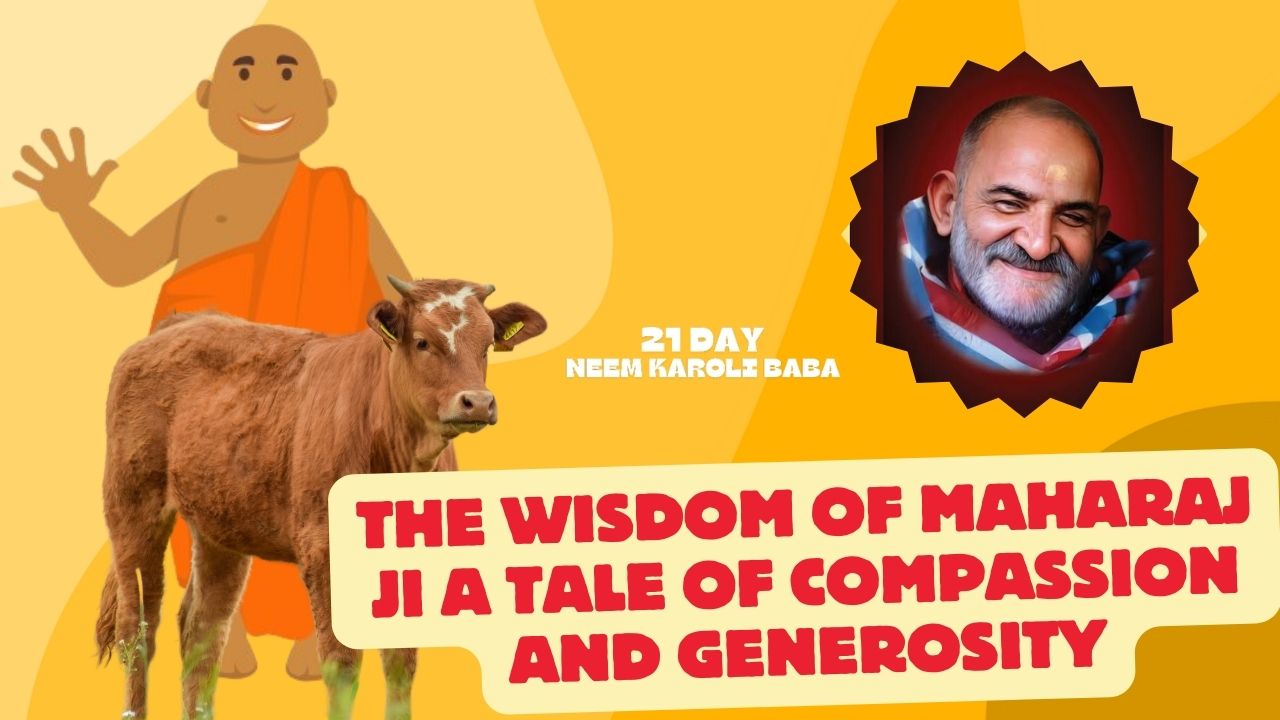

The Wisdom of Maharaj Ji A Tale of Compassion and Generosity
The Wisdom of Maharaj Ji A Tale of Compassion and Generosity: One day, while walking around, Maharaj Ji, also known as Neem Karoli Baba, reached a Sadhu’s Ashram. First, he walked around the Ashram and observed everything the Sadhu had collected. He noticed the cows, the grains, the supplies, and the offerings. Then, Maharaj Ji went to the Sadhu and asked, “How many cows are there? How much is the income, and how much milk do they produce?”
The Sadhu, flattered by the attention, proudly recounted his possessions and income, emphasizing the abundance of milk produced by his cows. Maharaj Ji listened patiently and then requested, “Please give us a glass of milk.”
To Maharaj Ji’s surprise, the Sadhu refused. “Where is the milk, Baba? There is nothing here,” he said dismissively. Maharaj Ji, undeterred, asked again for a glass of milk, but the Sadhu continued to deny him. Frustrated by the Sadhu’s refusal, Maharaj Ji eventually got up and left the Ashram, but he knew he had to bring the Sadhu onto the right path.
Some time passed, and the Sadhu’s life began to change in unexpected ways. One day, while searching for Maharaj Ji, the Sadhu fell at his feet, tears streaming down his face. “Maharaj Ji, please forgive me,” he pleaded. “Ever since our encounter, the cows in my Ashram have stopped giving milk. I don’t understand what has happened.”
Maharaj Ji looked at him with compassion and said, “The path of a true Sadhu is not just to collect and keep, but to give and share. Whoever comes to your Ashram should receive some Prasad. Learn not just to take, but to give. If someone asks for something and you have it, do not refuse.”
The Sadhu listened intently as Maharaj Ji continued, “Generosity and kindness are the foundations of a good life. Your role as a caretaker of this Ashram is not just to accumulate wealth but to distribute it wisely and compassionately. Remember, true wealth lies in giving, not in hoarding.”
Inspired by Maharaj Ji’s wisdom, the Sadhu returned to his Ashram with a renewed sense of purpose. He began to offer prasad to every visitor who came, no matter how small or insignificant the offering might seem. He shared milk, food, and blessings generously, embodying the principles Maharaj Ji had taught him.
Over time, a miraculous transformation took place. The cows started giving more milk than ever before, and the Ashram flourished with prosperity and goodwill. The Sadhu realized that Maharaj Ji’s teachings were not just words but a profound truth that had the power to change lives.
Maharaj Ji’s lessons extended beyond the Ashram. He often taught that the same principles applied to householders as well. Whenever a devotee came to him, he would say, “Sai, please give me this much; I don’t want to stay hungry. May the Sadhu not go hungry.” His message was clear: everyone has a duty to share their blessings, to feed the hungry, and to help those in need.
Maharaj Ji’s presence and teachings continued to inspire countless devotees. His simple yet profound wisdom echoed in the hearts of those who met him. He showed that true spirituality is about compassion, generosity, and selflessness. By giving selflessly, one could find true peace and fulfillment.
The Legacy of Maharaj Ji’s Teachings
The Sadhu’s Ashram became a beacon of hope and generosity in the region. People came from far and wide to receive blessings and prasad, knowing they would be welcomed with open arms and a giving heart. Maharaj Ji’s influence spread, and many other Ashrams and households adopted his teachings of compassion and generosity.
Maharaj Ji’s story reminds us all of the importance of giving and sharing. His teachings live on in the hearts of those who continue to practice his principles, making the world a better, kinder place, one act of generosity at a time.
Jai Sia Ram!
Join Us On Instagram at 21dayneemkarolibaba
Background: What This Tale Teaches
The tale above tells of a Sadhu who measured his life by what he had collected, and who learned, through Maharaj Ji, to measure it by what he gave. The story is not about poverty. The Sadhu had an ashram, and later, as the tale describes, his circumstances changed. The story is about the direction of attention: whether a person looks at what is coming in, or at what is going out to others. That change of direction is the heart of the teaching associated with Maharaj Ji: love all, serve all, and remember God.
It helps to read the tale as a mirror rather than as a report. Most readers will not live in an ashram, and most will not face the exact situation in the story. The question the tale asks is simpler: in your own life, where are you collecting, and where are you giving? Giving does not have to mean money. It can mean time, attention, patience, food, or a kind word. The tale suggests that generosity is not a loss. It is a way of living that changes the giver first.
The tale also shows how teaching worked in the tradition described on this site. Maharaj Ji did not, in this story, give a long lecture. He asked a question, waited, and let the Sadhu see the answer for himself. That is a useful model for a reader. A story that makes you pause and look at your own life has done its work, even if you do not remember every detail of the plot.
A Simple Daily Practice
Ram Naam Jap
Ram Naam Jap means repeating the name Ram with attention. You can sit quietly for a few minutes in the morning, or repeat the name while walking or waiting. Choose a time you can keep, start with a small number of repetitions, and let the practice grow on its own. If the mind wanders, return without scolding yourself. The repetition itself is the practice.
Hanuman Chalisa
Maharaj Ji is remembered as a devoted worshipper of Hanuman Ji, and the Hanuman Chalisa is central for many of his followers. Read it slowly once a day, or listen to a recitation and follow along. You do not need to understand every line at first. A steady daily habit builds familiarity, and familiarity builds steadiness. On days when you cannot sit for long, even one careful reading is enough.
Seva
Seva means selfless service, and it is the practical form of the generosity in this tale. Seva can be as simple as feeding someone, helping a neighbour, offering water to a visitor, or supporting a community meal when you are able. The spirit of seva is to serve without expecting praise or a result. If you give, give quietly, and let the giving be its own reward.
Practical Guide: Living Generosity Day by Day
Generosity can be practised in small, regular ways. Choose one act you can repeat each week: a meal for someone who needs it, a small donation made quietly, help for a neighbour, or time given to a community task. Keep it within your means. Giving that leaves you resentful or in difficulty is not the aim. The aim is a steady, sustainable habit of giving.
It also helps to give attention. Listen without interrupting, visit someone who is lonely, and speak gently to the people who serve you each day. These acts cost nothing, and they are often the ones that are remembered. If you are in a position to give money, give what you can without expecting recognition, and keep the rest of your responsibilities in order. Generosity and prudence belong together.
Frequently Asked Questions
What is the main lesson of this tale? The tale points to generosity and kindness as the foundations of a devotional life. It suggests that a life measured by giving, rather than by collecting, is the path the story holds up for the reader.
Does generosity mean giving away everything? No. The tale does not ask a reader to give away everything. It asks for a change of direction: to give regularly, within your means, and without expecting praise or a result.
How can I practise generosity if I have little to give? Give time, attention, patience, food, or a kind word. Visit someone who is lonely, help a neighbour, or offer water to a visitor. Small acts, done regularly, are the practice.
How does this tale connect with daily prayer? Prayer and generosity belong together in the teaching associated with Maharaj Ji. Prayer steadies the mind, and seva carries that steadiness into the day. Ram Naam Jap, the Hanuman Chalisa, and seva are a simple daily form of that teaching.
Related Reading
Neem Karoli Baba History – background on Maharaj Ji, his life, and his teachings.
A Journey of Faith How Neem Karoli Baba Entered My Life – a devotee testimony about how faith grows through small moments.
How to pray to Neem Karoli Baba – simple steps for prayer at home, including Ram Naam Jap, the Hanuman Chalisa, and seva.
Facebook 21day