Neem Karoli Baba (नीम करौली बाबा), called Maharaj Ji by his devotees and also spelled Neeb Karori Baba, was an Indian saint who spent his life around Hanuman temples, ashrams and ordinary people who turned up with problems. He died in 1973. People still travel to Kainchi Dham to sit where he sat, and each year more readers find him through the book Be Here Now, through documentaries, and lately through two Hindi films.
This page is a starting point. It covers who he was, how he got his name, what he taught, and where to read more on this site. Where a story rests on devotee memory and not on documents, I say so.
Who was Neem Karoli Baba?
He was born Lakshman Narayan Sharma around 1900 in a Brahmin family in Uttar Pradesh. Sources disagree on the exact village, and Akbarpur is the one you see most often. Dates from that period are loose, and it is better to say so than to pretend otherwise.
As a young man he left home and wandered. He later returned for a few years of family life and then left again. Different places gave him different names: Lakshman Das, Handi Wala Baba, Tikonia Wala Baba, Tallaiya Baba in Gujarat, Chamatkari Baba in Vrindavan, and Blanket Baba, because he was rarely seen without one.
How did he get the name “Neem Karoli”?
The name comes from Neem Karoli (also written Neeb Karori), a village in Farrukhabad district where he spent time in his early years. A popular story says he was put off a train for traveling without a ticket, and the train would not move until he was allowed back on. Nothing in the historical record confirms it, so treat it as devotional tradition.
The plainer explanation is the village itself. His Western followers found “Karori” hard to pronounce, and “Neem Karoli” became the common form.
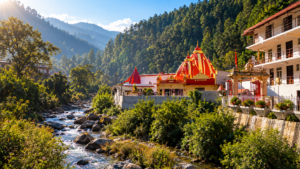
Kainchi Dham
When people say “Maharaj Ji’s ashram” they usually mean Kainchi Dham, near Nainital in Uttarakhand. It was established in 1964 on land given by a local man named Purnanand, and it has a Hanuman temple at its centre. After his death his ashes were installed there and a temple was built.
He had other ashrams too, in Vrindavan, Rishikesh, Hanumangarhi and the village of Neem Karoli, plus a centre in Taos, New Mexico. He left his body at Vrindavan on 11 September 1973.
Read more: Neem Karoli Baba’s Miracles: The Stories That Still Draw Thousands to Kainchi Dham
Hanuman at the centre
Almost everything about him comes back to Hanuman. Devotee accounts say he had around 108 Hanuman temples built, though that number is traditional and hard to check. When visitors asked where to find Neem Karoli Baba, he is said to have told them to go pray at the Hanuman temple, and described himself as the one who hands out prasad.
Many devotees believe he was Hanuman in human form. He deflected that kind of credit whenever it came his way.
Read more: Every Line of Hanuman Chalisa Holds Divine Power and Benefits of Worshipping Hanumanji
His teachings: Love, Serve, Remember
His motto was short: Love, Serve, Remember. He also said “Sub Ek”, all is one. He did not ask anyone to change religion, and he told people of every background roughly the same thing: love people, feed them, and keep God’s name on your tongue.
He sent visitors to the kitchen more often than to a book. Serve whoever is in front of you. Repeat Ram’s name. That is most of it, and it is harder than it sounds.
Read more: 3 Core Teachings on Love, Service & Devotion, The Essential Guide to His Teachings and Premanand Maharaj on Naam Jap and Guru Smaran
Miracles and devotee stories
In Vrindavan he was known as Chamatkari Baba, the miracle Baba. Devotees tell of him knowing what people were thinking before they spoke, and of ashram food that never ran out at a bhandara. A couple of years after his death, Swami Chidananda of the Divine Life Society wrote that close devotees reported seeing him in two places at the same time.
Some of these accounts also have ordinary explanations, such as how an ashram organizes service and food. I am not here to settle that for you. These are stories from people who were there, or who heard them from people who were.
One that stayed with me is the story of a wedding-day accident and a fakir at Siddhi Ma’s gate: How Rabbu Dada Survived His Wedding Day Accident
The Western devotees
Richard Alpert met him in 1967 and received the name Ram Dass, “servant of Ram.” Ram Dass’s book Be Here Now, along with the writing and singing of Bhagavan Das and Krishna Das, is a big reason the West knows his name at all.
There are also several documentaries about him and his devotees, including American Yogi, Windfall of Grace and Moved by Grace.
Steve Jobs, Zuckerberg and the tech connection
This is the part most often told wrong. Steve Jobs traveled to India in 1974 and went to Kainchi Dham, but Neem Karoli Baba had died the year before. They never met. Mark Zuckerberg has said he visited in 2015 after Jobs’s advice.
Read the full account: Neem Karoli Baba and Steve Jobs: The Story Nobody Tells Fully
Why more people are searching for him in 2026
Two Hindi films about him came out in 2026: Shree Baba Neeb Karori Maharaj, with Subodh Bhave in the lead role, and Hanuman Ansh. If you are here after watching one of them, the sections above and the posts below are a good place to continue.
More Neem Karoli Baba stories on this site
- The Hidden History of Neem Karoli Baba
- The Hidden Truth About God: Neem Karoli Baba’s Essential Teachings
- Rabbu Dada’s Wedding Day Miracle
Frequently asked questions
Who was Neem Karoli Baba?
A Hindu saint and Hanuman devotee, born around 1900 in Uttar Pradesh and known to followers as Maharaj Ji. He is best known for Kainchi Dham and for the teaching Love, Serve, Remember.
When did Neem Karoli Baba die?
He left his body at Vrindavan on 11 September 1973.
Where is Kainchi Dham?
Near Nainital in Uttarakhand, on the Nainital to Almora road. The ashram was established in 1964.
Why is he called Neem Karoli Baba?
After the village of Neem Karoli (Neeb Karori) in Farrukhabad district, where he spent time early in life.
Was Neem Karoli Baba Hanuman?
Many devotees believe he was a form of Hanuman. He never made that claim himself and usually pointed people to the Hanuman temple instead.
What does “Sub Ek” mean?
“All is one.” It was one of his most repeated sayings and sums up his view that all people and all paths are connected.
Did Steve Jobs meet Neem Karoli Baba?
No. Jobs visited Kainchi Dham in 1974, a year after Baba’s death.
Sources and further reading
- Wikipedia: Neem Karoli Baba and Kainchi Dham
- Hindupedia: Neem Karoli Baba
- Penguin India: Who was Neem Karoli Baba? (from Sri Siddhi Ma)
- Swami Chidananda, Divine Life Society: Baba Neem Karoli, A Wonder Mystic of Northern India