
Complete guide: Neem Karoli Baba: Life, Miracles & Teachings
What Premanand Maharaj Said About Connecting With Neem Karoli Baba
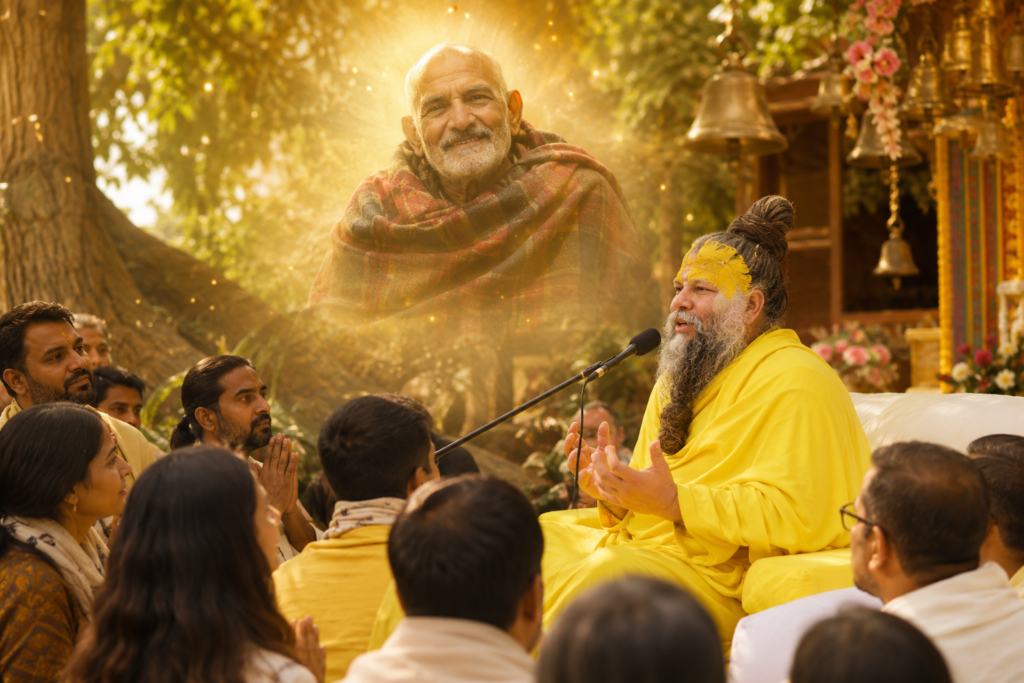
A family walked into Premanand Maharaj’s court in Vrindavan not long ago and said something that made the room go quiet. They told him they used to be devotees of Neem Karoli Baba, but since Baba is no longer here in body, they have started seeing Premanand Maharaj himself as their guru. Then they asked, “Is that guru aparadh?” Is it wrong to shift devotion like that?
It’s a fair question, and it’s the kind of question a lot of people are quietly sitting with right now. Neem Karoli Baba left his body in 1973. Anyone who wants his darshan today only has photographs, old stories, and the temple at Kainchi. So how do you actually connect with a guru who isn’t physically around anymore?
Premanand Maharaj’s answer was simple, and honestly, kind of freeing: the guru’s real place was never the body. It’s the heart. You don’t need Baba sitting in front of you for the relationship to be real.
Why This Question Even Came Up
To understand why this exchange mattered, you have to understand who was asking. This wasn’t some random visitor testing Premanand Maharaj with a trick question. This was a family that had grown up with Neem Karoli Baba’s name in their house—the kind of household where Hanuman Chalisa gets read every morning, and Baba’s photo sits on the shrine next to Ram and Hanuman. People like that don’t switch gurus casually. When they told Premanand Maharaj they’d started seeing him as their guru figure, it came from a place of real confusion, not convenience.
That confusion is common. A huge number of Neem Karoli Baba’s devotees today never met him. He left his body in 1973, which means anyone under the age of about sixty had no chance of physical darshan. What they have instead is inherited devotion—stories passed down from parents and grandparents, books like “Miracle of Love,” photographs, and the pull of Kainchi Dham itself. For a generation raised entirely on secondhand memory, it makes sense that a living saint like Premanand Maharaj, who speaks in a language they understand and answers questions in real time, would start to feel like the more accessible guru.
So the question “Is this guru aparadh?” isn’t really about etiquette. It’s about whether a relationship built on memory and imagination counts as real devotion, or whether devotion needs a living, breathing person in front of you to count at all.
Guru Smaran: Remembering Instead of Reaching
The word he kept coming back to was “smaran”—remembrance. Not a technique you perform for twenty minutes and forget. Something closer to keeping someone in mind the way you’d keep a person you love in mind, without trying.
Maharajji himself used to say something similar. There’s a line that gets quoted a lot on devotee sites: “When you remember me, I come to you.” Not “when you visit me” or “when you touch my feet. “When you remember me.
That’s the whole shift Premanand Maharaj is pointing at. You’re not trying to physically access Neem Karoli Baba. You’re maintaining a relationship in your own mind and heart, and that relationship is treated as just as real as any conversation in a room.
This is actually a fairly old idea in Indian bhakti traditions, even if it sounds modern when phrased this way. Mirabai never had ongoing physical access to Krishna, yet her entire life is remembered as one continuous act of remembrance. Tulsidas wrote the Ramcharitmanas centuries after Ram’s time, working purely from memory, faith, and inner vision. The pattern repeats itself: the strongest devotional relationships in this tradition are rarely built on constant physical proximity. They’re built on a mind that keeps returning to the same presence, again and again, until the returning itself becomes effortless.
Premanand Maharaj isn’t inventing something new here. He’s applying an old principle to a very specific, very modern problem—what do you do when the guru you feel closest to has been gone for over fifty years, and you only know him through other people’s stories?
Naam Jap: The Practice That Ties It Together
The other piece he mentioned was naam jap—repeating the name. This isn’t unique to Neem Karoli Baba devotees; it shows up across almost every Indian devotional tradition. But there’s a reason it keeps getting recommended specifically for people trying to stay connected to a guru who has passed on.
Naam jap doesn’t require a temple, a specific time, or anyone else’s presence. You can do it standing in line at the bank, walking to work, lying awake at 2 a.m. It travels with you. And because it’s repetitive, it slowly stops feeling like an “exercise” and starts feeling like background noise your mind returns to on its own, which is close to what smaran is supposed to become anyway.
Practically, this is where a lot of devotees get stuck. They know they’re supposed to “remember” Baba, but remembrance without a routine tends to fade after a few weeks. Naam jap gives smaran a body to live in. It’s the daily habit; samaran is the state that habit is trying to produce. One devotee described it this way: you don’t wait for the feeling of devotion before you start chanting—you chant, and the feeling shows up somewhere in the middle, usually when you’re not checking for it.
Neem Karoli Baba himself pointed people toward the Hanuman Chalisa specifically, telling followers that every single line of it functions as a maha-mantra. That’s not a small claim. It means the forty verses aren’t just praise poetry—each one is treated as carrying enough power on its own to be a complete practice. For someone looking for a concrete starting point, that’s about as concrete as it gets: pick up the Hanuman Chalisa, read it daily, and let the naam jap build from there.
Why This Is Getting Attention Right Now
Premanand Maharaj’s videos travel fast on social media these days—there’s rarely a week without a new clip doing the rounds. And Neem Karoli Baba has never really left the picture either; his followers span everyone from Steve Jobs, who visited Kainchi in his twenties before building Apple, to Indian celebrities who still make the trip to Nainital.
Virat Kohli and Anushka Sharma are a good example of how these two figures keep showing up together in the same conversation. The couple has visited Kainchi Dham with their daughter, sat quietly under the trees there, and separately made trips to Premanand Maharaj’s ashram in Vrindavan after Kohli’s Test retirement. When people search for one name, the other tends to surface in the same breath—not because anyone’s forcing the connection, but because a lot of modern devotees genuinely move between both.
What’s interesting is that Premanand Maharaj doesn’t try to separate himself from that lineage. When devotees bring Neem Karoli Baba’s name into his court, he doesn’t correct them or redirect them entirely to himself. He answers from inside the same framework Baba taught—that a guru’s form matters less than the devotion itself.
For someone who found Neem Karoli Baba through an old story, a Steve Jobs biography detail, or a family tradition and now wonders if that connection is somehow “over” because Baba isn’t alive—this is probably the most direct answer you’ll find. It isn’t over. It was never about the body in the first place.
What This Looks Like Day to Day
It’s one thing to hear “remember him” and “chant his name” and nod along. It’s one thing to actually build a life around it. A few things tend to help, based on how long-time devotees describe their own routines.
Start small and fixed. Rather than an open-ended “I’ll remember Baba throughout the day,” pick two or three exact moments—waking up, before a meal, before sleep—and anchor smaran there. Fixed moments turn into habits faster than vague intentions do.
Keep a physical trigger nearby. A photo of Maharajji on a desk, a small idol, even a phone wallpaper. The trigger isn’t the devotion itself, but it interrupts the day often enough to pull your mind back to remembrance.
Let naam jap fill dead time. Commutes, queues, chores — these are the minutes most people write off as wasted. They’re exactly the minutes Naam Jap is built for, since it needs nothing but attention.
Visit Kainchi Dham when you can, but don’t wait for it. For many devotees, the trip to Nainital is once a year, sometimes once in a lifetime. Treating that visit as the only real connection point puts the entire relationship on hold for months at a time. The daily practice is what the visit is supposed to deepen, not replace.
The Takeaway
If you’re trying to build a genuine connection with Neem Karoli Baba, the shape of it is simpler than it sounds:
- Stop waiting for a physical sign or presence. Start with remembrance — think of him the way you’d think of someone you trust completely.
- Add naam jap as a daily habit, not an occasional ritual. Even a few minutes on a commute counts.
- Visit Kainchi Dham if you can, but don’t treat the visit as the only place the relationship exists.
Guru, Aparadh isn’t about which saint’s name you say. It’s about whether the devotion is genuine. Premanand Maharaj’s answer, in the end, is really Neem Karoli Baba’s own teaching handed back to a new generation.
Facebook: 21day
Instagram: 21dayNeemKaroliBaba