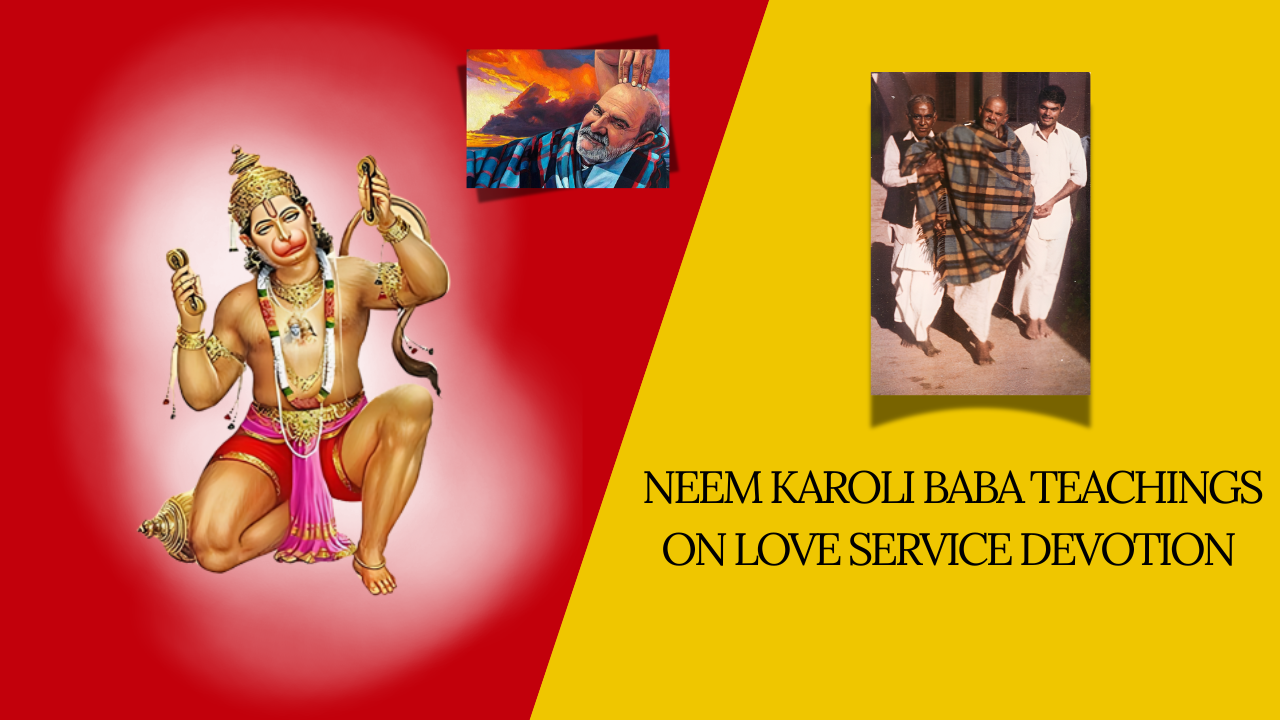
There’s a story devotees tell about Maharajji that has stayed with me.
A man once came to Kainchi Dham carrying a heavy heart — no job, broken family, nowhere to go. He didn’t even know why he was there. He just felt pulled. When he sat before Neem Karoli Baba, Maharajji didn’t ask him anything. He simply looked at him for a long moment and said, “Feed someone today. Just feed one person.”
The man was confused. He had come for answers. He got a task instead.
But that evening, he bought a small meal for a beggar near the ashram. Something in him shifted. He came back the next day. And the day after. Within a few months, his life had turned around — not because of magic, but because a simple act of love had reconnected him to something larger than his own problems.
That story holds all three of Maharajji’s core teachings inside it — love, service, and devotion — not as abstract philosophy, but as something you actually do.
This post breaks down each one, shows you what Maharajji really meant, and gives you a practical way to begin — today.
Why Neem Karoli Baba’s Teachings Still Matter in 2025
Before we get into the teachings, let’s understand why a blanket-wrapped saint from a small village in Uttarakhand is still being talked about by millions of people worldwide — including Steve Jobs, Mark Zuckerberg, and Ram Dass.
The answer is simple: he didn’t teach religion. He taught reality.
Maharajji never gave long discourses. He never wrote a single book. He sat on a wooden bench, fed people, and sent them away with a few words or a glance. And yet, those few words changed entire lives.
His philosophy rested on four words that he repeated to everyone who came to him:
“Love everyone. Serve everyone. Remember God. Tell the truth.”
That’s it. No rituals required. No special qualifications. No caste, no country, no religion — welcome, all of you.
Let’s go deep into the first three.
Teaching 1: Love Everyone — Even When It’s Hard
“The best form of worship is to love each other.” — Neem Karoli Baba
What Maharajji Actually Meant
When Maharajji said “love everyone,” he wasn’t talking about a feeling. He was talking about a practice — something you choose moment to moment.
He loved a corrupt official the same way he loved a poor rickshaw puller. He didn’t look at people’s past, their sins, their status. He looked at the soul inside. His devotees often noticed that Maharajji would give more attention — more love — to the people who seemed the most broken.
Ram Dass, the Harvard-educated psychologist who became one of Maharajji’s closest Western disciples, described it this way: when he sat before Maharajji, he felt as though someone could see every dark, shameful corner of his mind — and loved him anyway. Completely. Without condition.
That kind of love is not sentimental. It is fierce. It requires you to look past the surface of people — the rudeness, the selfishness, the mistakes — and recognize the divine in them.
Maharajji used to say: “God lives in everyone. When you see a person, you are seeing God.”
This is not a metaphor. This is the practice.
The Block That Stops Most People
The biggest challenge with this teaching is our ego. We feel we can’t love someone who hurts us. Someone who lied to us. Someone we find difficult.
Maharajji understood this. He didn’t ask you to pretend bad behavior is good. He asked you to separate the action from the soul. You can be angry at what someone did while still holding compassion for who they are.
This is not a weakness. This is one of the hardest spiritual practices there is.
How to Practice Love Daily
You don’t need to achieve some elevated spiritual state to begin. Start here:
Morning (2 minutes): Before you pick up your phone, think of one person in your life who is difficult for you — a coworker, a relative, someone who irritated you recently. Say internally: “I see the divine in you.” You don’t have to feel it yet. Just say it.
During the day: When someone is rude or dismissive, pause for three seconds before reacting. Ask yourself: “What might be hurting them right now?” This single pause is love in action.
Evening: Think of one person you helped today — even in a tiny way. Even holding a door. That was Maharajji’s love moving through you.
Do this for 21 days. The shift is real.
Teaching 2: Serve Everyone — Seva Is the Shortcut to God
“The best way to find God is to serve others. Seva is the highest worship.” — Neem Karoli Baba
What Seva Really Means
In India, we throw the word “seva” around a lot. But Maharajji’s understanding of seva was very specific.
Seva is not charity. Charity can come with ego — “I am the giver, you are the receiver.” Maharajji’s seva had no ego in it. He taught that when you serve another person, you are not helping a human being — you are serving God in human form.
This is why he said: “A suffering man is higher than God.”
Think about that. The hungry person at your door is higher than God — because serving them IS serving God.
This is why at every ashram associated with Maharajji, food was — and still is — given freely to anyone who comes. No questions asked. No religion checked. Come, eat. You are God. Let me feed you.
Seva Without Expectation
Here’s the trap most people fall into: they do service but secretly expect something back — gratitude, recognition, karma points.
Maharajji saw through this immediately. He would sometimes accept seva from one devotee and then loudly praise another person to that same devotee — just to watch whether their ego would flare up.
True seva asks nothing. It doesn’t need to be seen. It doesn’t need a thank you.
He once told a devotee who was feeling unappreciated: “Do your work. God is watching. That is enough.”
How to Practice Seva Daily
Seva doesn’t require a temple or an NGO. It can start right where you are.
Small seva (daily): Feed someone — a stray animal, a hungry child, a neighbor. Even one cup of chai shared with sincerity is seva.
Medium seva (weekly): Give one hour of genuine help — not money, but presence. Help a colleague with a problem. Sit with an elderly person. Cook a meal for someone who is struggling.
Large seva (monthly): Volunteer somewhere that has nothing to do with you personally — a school, a hospital, a shelter. Go as a nobody. Don’t post about it.
The 21-day practice works beautifully here — commit to one small act of seva every single day for 21 days. By day 10, you will start to feel something open in you that no meditation technique could have opened.
Teaching 3: Devotion (Bhakti) — Remember God in Everything
“Chant the name of Ram. It is the greatest mantra. Everything is contained in it.” — Neem Karoli Baba
Bhakti Is Not Religion — It’s a Relationship
When Maharajji spoke about devotion, people from every religion felt included. He quoted the Quran to Muslim devotees, spoke of Christ to Western seekers, and chanted Ram with Hindu disciples — all in the same afternoon.
He was not interested in which religion you practiced. He was interested in whether your heart was turned toward the divine, whatever name you gave it.
Bhakti, at its core, is simply remembrance. It is the practice of keeping God in your awareness throughout the day — not just during prayer time, but while you cook, work, drive, and talk to people.
Maharajji’s own practice was continuous Ram-naam — chanting “Ram Ram” internally at all times. He described it as being like breathing. You don’t decide to breathe. It just happens. That’s what Ram-naam became for him.
Why Devotion Is the Foundation of the Other Two
Here’s something most people miss: love and seva are possible because of bhakti. Without a sense of the divine in everything, serving someone rude to you feels pointless. Loving someone who hurt you feels impossible.
But when you genuinely feel that God is present in every person and every moment, love becomes natural, and seva becomes joyful.
Maharajji’s three teachings are not three separate practices. They are one integrated way of being, and bhakti is the root that feeds the other two.
How to Practice Devotion Daily
You don’t need to be Hindu. You don’t need to know the Hanuman Chalisa by heart. Start small:
Morning anchor: Before you begin your day, sit quietly for 5 minutes. Light a diya if you have one. Just breathe and think of something you’re grateful for. That gratitude is devotion.
Ram-naam (or your mantra): Start with just 108 repetitions of “Ram Ram” — it takes under 5 minutes. Use a mala if you have one. If not, your fingers work fine. The point is not the counting — it is the turning of the mind toward the divine.
Before sleeping: Review your day and find one moment where you felt something larger than yourself — a sunset, a kind word, a moment of peace. Thank God for it. That’s bhakti.
How All Three Work Together — A Daily Practice Framework
Maharajji never separated these teachings because they’re not meant to be separate. Here’s a simple daily structure that brings all three together:
| Time | Practice | Teaching |
|---|---|---|
| Morning (5 min) | Sit quietly, 108 Ram-naam, set an intention of love | Bhakti + Love |
| During the day | One conscious act of service — however small | Seva |
| Evening (5 min) | Reflect on the day, find one moment of grace | Bhakti |
| Before sleep | Think of one difficult person and send them love | Love |
This is essentially the foundation of the 21-day practice — one day at a time, one teaching at a time, until it becomes who you are rather than what you do.
FAQ: Neem Karoli Baba’s Teachings on Love, Service & Devotion
Q1. What are Neem Karoli Baba’s 3 core teachings?
Maharajji’s three core teachings are unconditional love (prem), selfless service (seva), and devotion to God (bhakti). He summarized them in four words: “Love everyone, serve everyone, remember God.” These are not abstract ideas — he taught them through direct action in daily life.
Q2. Can I practice Neem Karoli Baba’s teachings at home without visiting an ashram?
Yes, absolutely. Maharajji never insisted on visiting any specific place. He said, “When you remember me, I come to you.” You can practice love, seva, and bhakti in your home, your workplace, and your neighborhood. The ashram is inside you.
Q3. What is seva according to Neem Karoli Baba?
Seva means selfless service — helping others without expecting anything in return, not even gratitude. Maharajji believed that every suffering person is God in disguise, so serving them is the highest form of worship. Even feeding a stray dog or helping a stranger counts as seva.
Q4. How do I start devotion (bhakti) if I’m not religious?
Bhakti does not require a specific religion. Maharajji welcomed people of all faiths. Start with simple gratitude — five minutes of quiet thankfulness each morning. Ram-naam is the practice he recommended most, but any name of God from any tradition works. The heart’s intention matters more than the specific words.
Q5. What is the connection between Neem Karoli Baba’s teachings and the 21-day practice?
The 21-day practice is based on the principle that consistent small actions over 21 days can rewire how we think and feel. Applying Maharajji’s teachings — one act of love, one act of service, one moment of devotion per day for 21 days — creates a foundation of spiritual habit that slowly transforms daily life.
Q6. Why did Steve Jobs and Mark Zuckerberg visit Neem Karoli Baba’s ashram?
Steve Jobs visited Kainchi Dham in the 1970s during a personal and professional crisis. He was deeply moved by the atmosphere and Maharajji’s teachings on simplicity, service, and love. He later told Mark Zuckerberg to visit when Facebook was going through its own turbulent phase. Both found clarity in Maharajji’s simple message — that the purpose of life is not achievement, but love and service.
Q7. How long does it take to feel the effect of practicing these teachings?
Maharajji himself never promised timelines. But most devotees report feeling a shift within 21 days of consistent practice — not a dramatic spiritual awakening, but a quiet softening. The anger that used to rise instantly takes a moment longer. The kindness that felt forced starts to feel natural. That is the teaching working.
Conclusion: The Blanket-Wrapped Saint Who Changed the World
Neem Karoli Baba had no formal organization. No YouTube channel. No published books. He sat on a wooden bench, wrapped in a blanket, and loved people.
And somehow, that love traveled from a small ashram in the Kumaon hills to the boardrooms of Silicon Valley, to the hearts of millions of ordinary people searching for something real in an increasingly noisy world.
His three teachings — love, seva, and bhakti — are not complicated. They are demanding. They ask you to give what is hardest to give: your ego, your time, your conditional love.
But here’s what Maharajji promised in return: “Do this for 21 days and see what happens.”
He didn’t promise miracles. He promised transformation — the quiet, unassuming kind that starts when you feed one person, forgive one person, remember God for just five minutes before rushing into your day.
Start today. Start small. Maharajji is watching.
Jai Maharajji. Ram Ram.