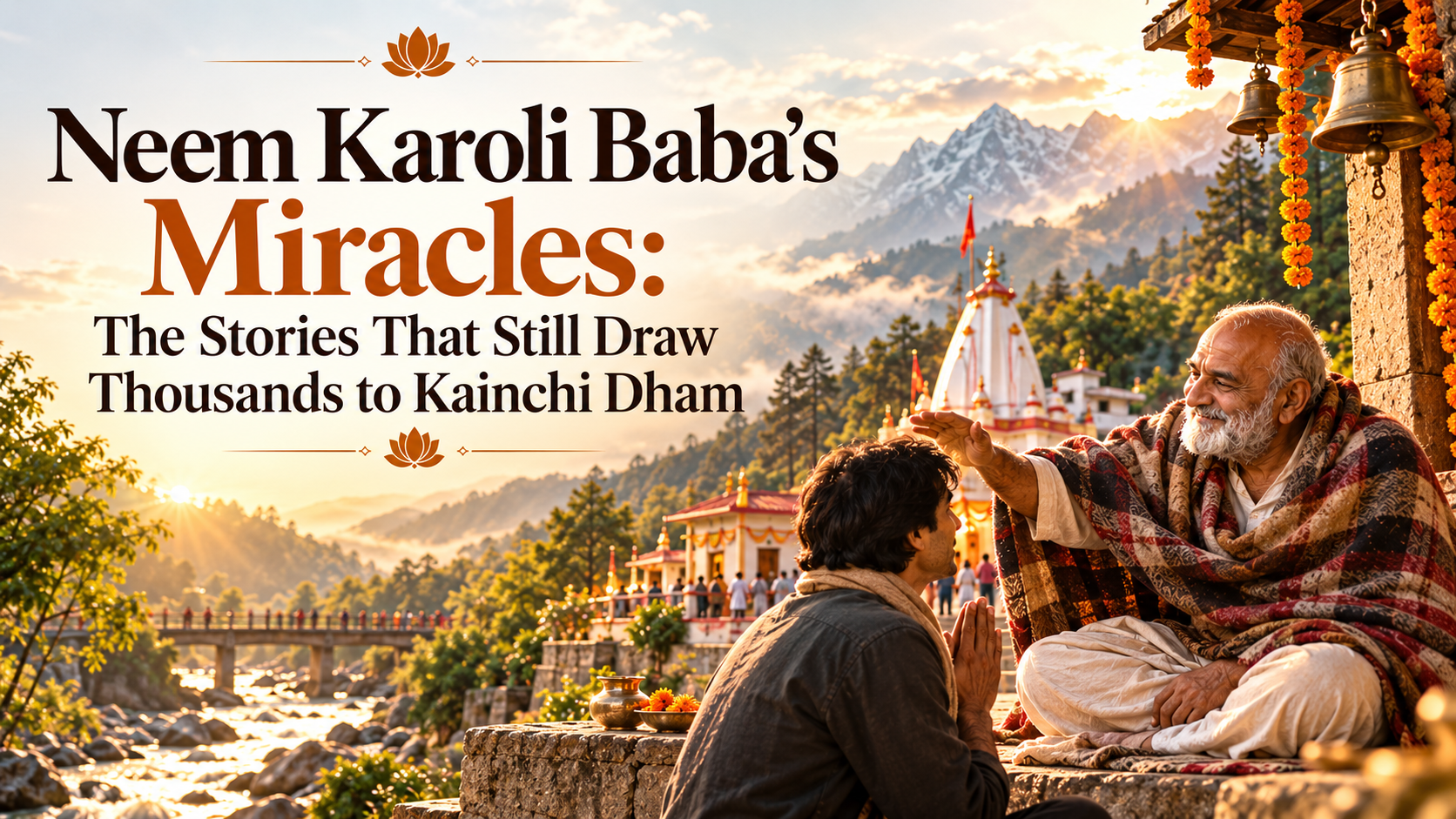
Neem Karoli Baba: Every year, close to two and a half million people make the trip up the winding Nainital-Almora road to a small ashram called Kainchi Dham. Most of them aren’t going for the scenery, though it’s beautiful. They’re going because of stories — stories about a man who died in 1973 but somehow still feels present enough that Silicon Valley tech founders, Bollywood actors, and rural villagers all end up standing in the same courtyard for the same reason.
Neem Karoli Baba’s miracles are the reason this place refuses to fade into history. I’ll admit upfront: some of these stories sound too clean, too neat, the kind of thing that gets exaggerated over fifty years of retelling. But talk to enough people who claim they were there, and a pattern starts to show up that’s harder to dismiss than any single story on its own.
Who Was Neem Karoli Baba, Actually?
Born Lakshman Narayan Sharma around 1900 in a village in what’s now Uttar Pradesh, he left home as a teenager to wander as a sadhu. He came back, married, had children, and lived what looked like an ordinary life for years — which is unusual, since most saints in Indian tradition renounce family entirely. He eventually settled at Kainchi in 1964, at an ashram built around a small Hanuman temple, and stayed there until his death in 1973.
He wasn’t a public speaker. He didn’t write books. Most of what we know about him comes secondhand, from devotees who wrote down what they saw. That secondhand quality is worth keeping in mind as you read the rest of this — it’s part of why skeptics push back, and it’s also part of why the stories have stuck around so stubbornly.

The Train That Wouldn’t Move Without Him
This is the story that, depending on who you ask, either started everything or gets told first because it’s the easiest to picture. Baba was riding a train near Neem Karoli village without a ticket. A conductor forced him off at the next stop. The train pulled out — and stalled a short distance down the track, for no reason the engineers could find.
Someone on board suggested, half-joking, that maybe the sadhu who’d just been thrown off should be brought back. He was. The train started moving again immediately.
Whatever actually happened mechanically that day, the story led to something concrete: the first ashram built in his name, in Neem Karoli village, which is also where he picked up the name people know him by today. He was never actually born with that name — it stuck because of this one incident.
Reading Minds Without Being Told Anything
A recurring theme across nearly every account of Baba is that he seemed to already know what people were thinking before they said a word. Devotees describe him repeating a prayer someone had only said silently in their own head. Others say he’d hand someone food they’d been mentally craving, unprompted. One well-documented account involves him recounting a visitor’s entire personal history — details about family, past events, private struggles — without ever having met them before.
His own explanation, when he bothered to give one, was almost dismissive: “He knows everything. You don’t have to tell him.” The “he” there is God, not Baba himself. That’s a detail people tend to skip over when they retell these stories — Baba consistently redirected credit away from himself, which is actually a little unusual for a guru with this level of following.
The Meeting That Reshaped Western Spirituality
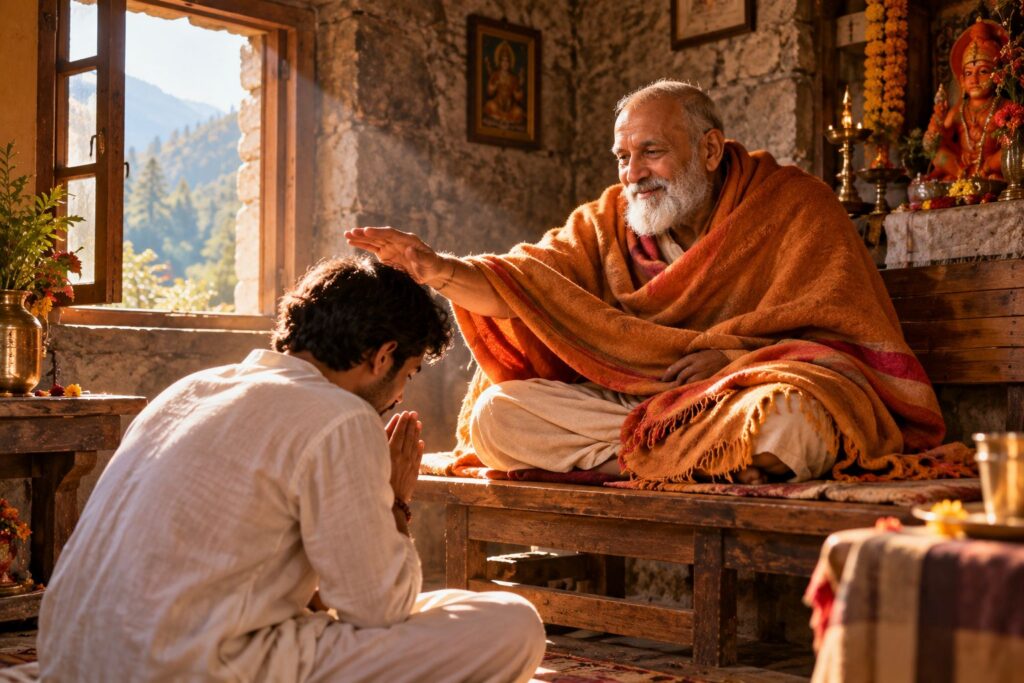
If you want the miracle story with the biggest ripple effect, this is it. In 1967, a Harvard psychology professor named Richard Alpert traveled to India, not looking for God, just looking for something to do after losing his university position over LSD research. He met Baba at Kainchi. In that first meeting, Baba told him specific details about his mother’s death back in the United States — a death from a spleen-related illness that no one in India could have possibly known about.
Alpert described it later as the moment his entire skepticism collapsed. He stayed, took the name Ram Dass, and eventually wrote “Be Here Now,” a book that ended up shaping an entire generation’s approach to spirituality in the West. Steve Jobs read it as a young man. So did a long list of tech founders, musicians, and writers who trace a straight line back to that one meeting at Kainchi.
It’s worth sitting with how strange this is. A guru who rarely left a small ashram in the Kumaon hills ended up, indirectly, influencing the design philosophy of Apple. That’s not a small claim, and it’s one of the reasons Neem Karoli Baba’s miracles get discussed outside purely religious circles.
Healing Stories: The Burned Child and the Paralyzed Devotee
Two stories come up constantly in oral accounts from Kainchi. In the first, a child fell into boiling water in a village and suffered severe burns. The family, too poor to afford real treatment, brought the child to Baba. He placed a hand on the child and said simply, “He will be fine.” Within hours, according to the account, the burns had healed completely, without scarring.
In the second, a man from Vrindavan arrived partially paralyzed. Baba touched his head and smiled — no ritual, no chanting, nothing elaborate. Within a few weeks, the man was walking on his own.
I won’t pretend these hold up to medical scrutiny, because they obviously can’t be verified the way a controlled study would require. But what’s consistent across both stories, and dozens like them, is Baba’s refusal to take credit. His go-to line was always some version of “Sab Ramji ka kaam hai” — it’s all Ram’s doing. Whether or not you believe the healing itself, that consistency of humility across five decades of stories from unrelated sources is at least a little unusual for a “miracle worker.”
Why the Miracle Stories Keep Spreading
Part of the reason Neem Karoli Baba’s miracles have outlived him by more than fifty years is that they were never marketed. There was no organization pushing these stories, no monetized following, no book deal in the early years. They spread the old-fashioned way — one devotee telling another, decade after decade, until Kainchi Dham grew from a quiet regional shrine into a site that pulls in millions of visitors annually, including celebrities and international pilgrims who’d never heard of the place a generation ago.
There’s also something to be said for the fact that Baba’s actual teaching undercuts the miracle obsession entirely. He wasn’t interested in being seen as magical. His most repeated instruction was blunt: love everyone, serve everyone, remember God, tell the truth. Feeding people mattered more to him than performing anything. If the miracles are true, they read less like party tricks and more like things that happened around a person who’d stopped caring about himself.
Visiting Kainchi Dham Today
If these stories pull you toward planning an actual visit, a few practical notes. September through November tends to be the calmer season, weather-wise. Tuesday evenings draw a bigger crowd because of the extended kirtan, so if you want quiet, avoid that slot. The site has gotten considerably more crowded in recent years — some longtime devotees have started complaining that the rush now makes it hard to sit and meditate the way people used to. If peace is the actual goal, weekday mornings are your best bet.
A Few Common Questions
Are Neem Karoli Baba’s miracles documented anywhere official?
Not in any medical or scientific sense. Most accounts come from devotee memoirs, oral history, and books like “Miracle of Love,” compiled from firsthand testimonies rather than independent verification.
Why is Neem Karoli Baba connected to Steve Jobs and Silicon Valley?
Through Ram Dass’s book “Be Here Now,” which influenced a generation of tech founders and spiritual seekers in the US during the 1970s and after.
What did Neem Karoli Baba actually teach, beyond the miracles?
Love everyone, serve everyone, remember God, and don’t lie. He emphasized service and feeding others over ritual or philosophy.
The Real Takeaway
You don’t have to accept every miracle story at face value to understand why they still matter. What holds up, story after story, is the consistency of the man behind them — someone who never used these events to build himself up, and who kept steering people back toward simple things: love, service, honesty. Whether or not you walk away believing in the train or the burned child, that part is hard to argue with.
Neem Karoli Baba and Steve Jobs: The Story Nobody Tells Fully