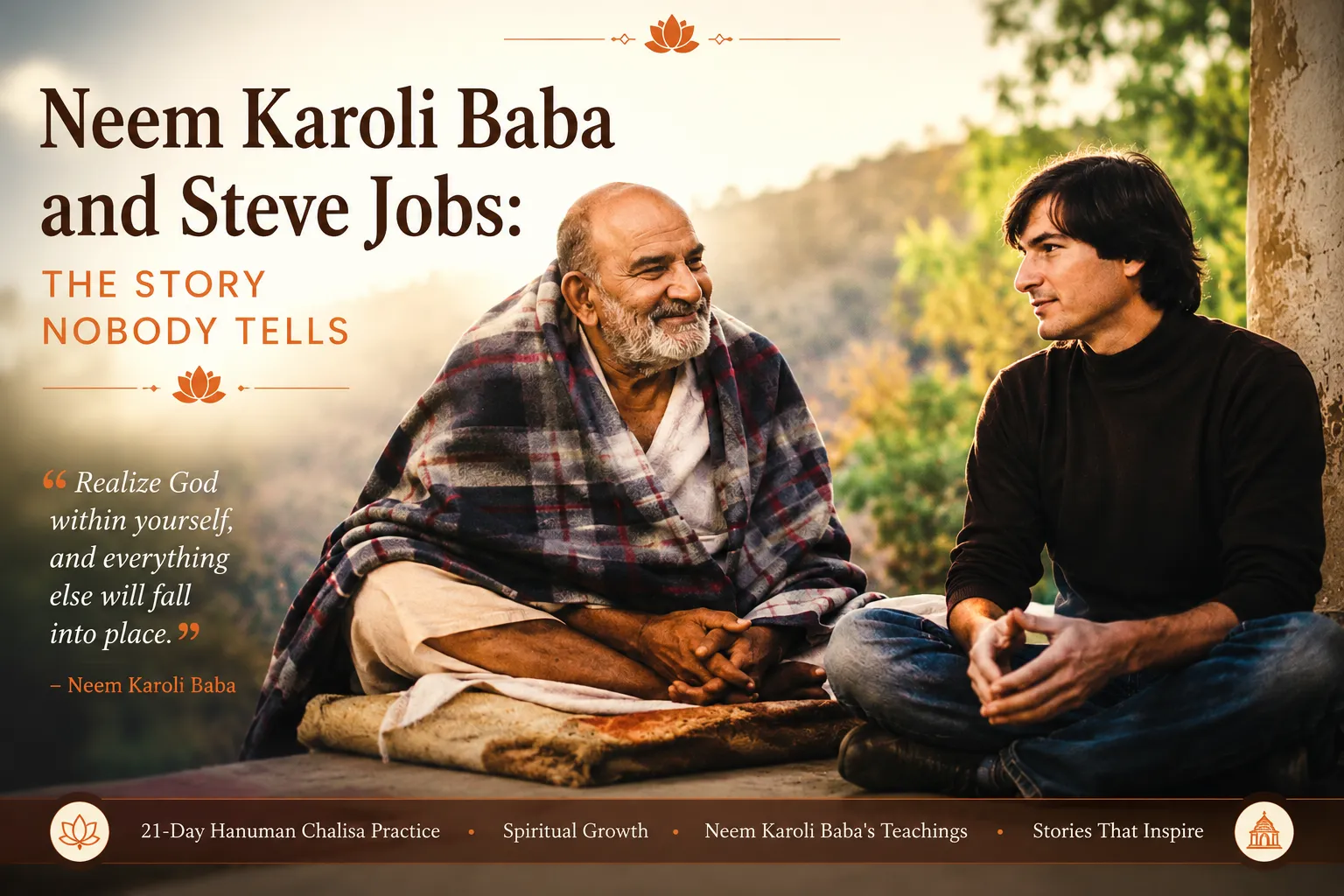
Steve Jobs came to Neem Karoli Baba’s Kainchi Dham in 1974 as a broke 19-year-old. One-way ticket. Shaved head. A question he couldn’t shake loose: Is there something more than what the West is offering?
He wasn’t looking for a product idea. He wasn’t doing research. He was genuinely lost — in the way that only happens when you’re smart enough to see through everything around you but haven’t found anything solid to replace it with.
He ended up at Kainchi Dham.
And whatever happened in those mountains above Nainital, next to that river, inside that small ashram — it followed him home. For the rest of his life.

The Trip That Changed Everything
Most people know Jobs visited India. Almost nobody talks about what he was actually looking for.
He and his college friend Dan Kottke had been reading Paramahansa Yogananda’s Autobiography of a Yogi—a book that Jobs loved so much it was reportedly one of only a few books downloaded on his iPad and the one he requested to be handed out at his memorial. That book sent them east.
They scraped together money, flew to Delhi, and spent months moving through the country. Eating cheap food. Walking long distances. Sitting in silence at places that didn’t care who you were or where you came from.
By the time they reached Kainchi Dham, Neem Karoli Baba had already left his body. He passed away in September 1973. Jobs arrived in 1974.
He didn’t leave. He stayed, sat in the ashram, and spent time with the people who had known Baba personally. Something about that place got into him in a way that didn’t wash out.
He came looking for enlightenment. He came back with something different — a kind of clarity about who he was and what he was meant to build.
Who Was Neem Karoli Baba? “Life, Teachings and Miracles
Who Was Neem Karoli Baba
If you’ve grown up in a devotee household, you already know. But for anyone arriving here through the jobs connection, here is the honest version, not the Wikipedia version.
Maharaj Ji was born around 1900 in a small village in Uttar Pradesh; his real name was Lakshman Narayan Sharma. He married young. Then one day, he walked away from everything and became a wandering sadhu. No announcement. No explanation. Just gone.
He spent years moving quietly through North India. No fixed ashram. No followers. Just a man who sat with people and loved them in a way that most people had never been loved before.
He didn’t write books. Didn’t give lectures. Didn’t charge anything. Didn’t tell anyone which god to worship or which religion was right.
What he did was look at you. Really look. And every person who sat with him — whether they were farmers from Kumaon or Harvard psychologists from America — said the same thing afterwards: he already knew everything about them. Not like a trick. Like a mirror that actually works.
His teaching, if you strip it down to the bone, was three things: love everyone, serve everyone, and remember God. Chant Ram’s name. Feed people when they’re hungry. That’s it. No initiation. No levels. No exclusive club.
Neem Karoli Baba’s Core Teachings: Love, Seva and Ram Naam
The miracles are their own conversation. The train stopped mid-track because he wanted to get off. Fires are going out. People recovering from illnesses that doctors had written off. Being seen in two places at the same time. His devotees don’t tell these as folk tales—they’re specific, named, dated accounts passed from person to person across generations.
Baba never claimed any of it. He always said the same thing: “I do nothing.” Everything is Ram’s will.”

What Jobs Actually Carried Home
This is where the story gets real.
Jobs returned to California, co-founded Apple, and over the next three decades built products that were—and this isn’t hype—genuinely unlike anything else being made. There was something about them that was hard to name at first. An obsessive attention to what the user actually felt. A refusal to add features just because engineers wanted to. A belief that taking things away is harder and more honest than piling things on.
Where did that come from?
Walter Isaacson, who spent years with Jobs writing his biography, said the India trip was one of the experiences Jobs returned to again and again when explaining how he thought. Jobs described watching people who had almost nothing live with a kind of presence and groundedness he hadn’t found in Palo Alto. It rewired something in him.
He came back and stripped away the clutter. Not just from his designs — from his whole way of thinking.
Maharaj ji lived and taught exactly this, not through speeches but through how he was. The idea that removing things is an act of love. That the most important thing you can do is focus on what matters and have the courage to cut everything else.
Look at the original Mac. The iPod. The iPhone. Each one is an exercise in removal. In saying no to a hundred things so that one thing can be perfect. Jobs was obsessive about this in a way that made engineers furious and also produced something nobody else was producing.
I’m not saying Maharaj ji designed the iPhone. But something passed between that ashram and that man. Something about what it means to serve the person in front of you with complete attention — and nothing extra.
Neem Karoli Baba and the Meaning of Seva
Then Mark Zuckerberg Came
In 2015, Facebook was having a hard stretch. Growth had slowed. There was pressure from investors, governments, and the public all at once. Zuckerberg was 30 years old, and the company he’d built had become, without anyone quite planning it, a piece of global infrastructure.
He came to India. And he went to Kainchi Dham.
Jobs had told him to go. Specifically. When you need clarity, go there.
Zuckerberg said publicly that the purpose of the visit was “to reconnect with what I believe in and to find that sense of hope.” He sat in the same ashram, walked the same grounds, sat under the same hills.
One of the most powerful technology executives alive, in a small mountain ashram in Uttarakhand, because a man who had sat there four decades earlier told him it would help.
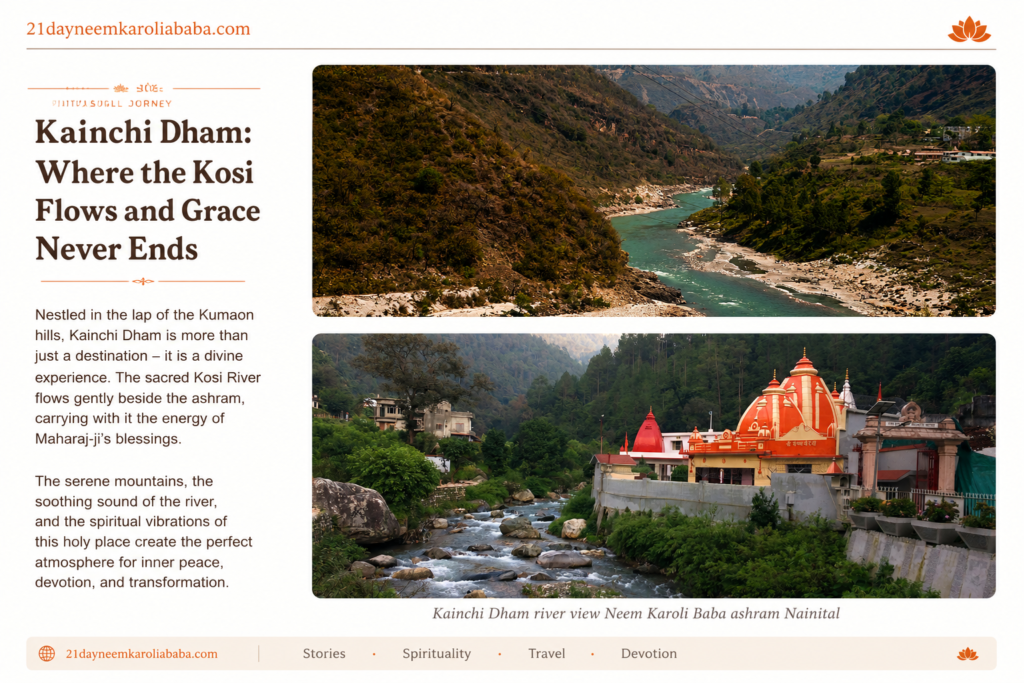
The place has a pull that doesn’t fully make rational sense. People feel it when they arrive. The Kosi River. The quiet. The photos of Maharaj Ji on the walls—eyes half-closed, wrapped in his blanket, looking at whoever’s looking at him with that expression that is simultaneously completely peaceful and completely present.
Baba never sought famous people. He didn’t have a strategy for influence. The people came because something in them had run out of road.
Kainchi Dham: How to Visit, What to Expect, and Why People Keep Coming Back
The 21-Day Connection — Why This Matters for Your Practice
Here’s what this has to do with you.
The “21-day” framework—the idea behind this entire site—is rooted in something Maharajji lived his whole life, not just preached. Not a quick fix. Not a life hack. A real, daily, sustained practice.
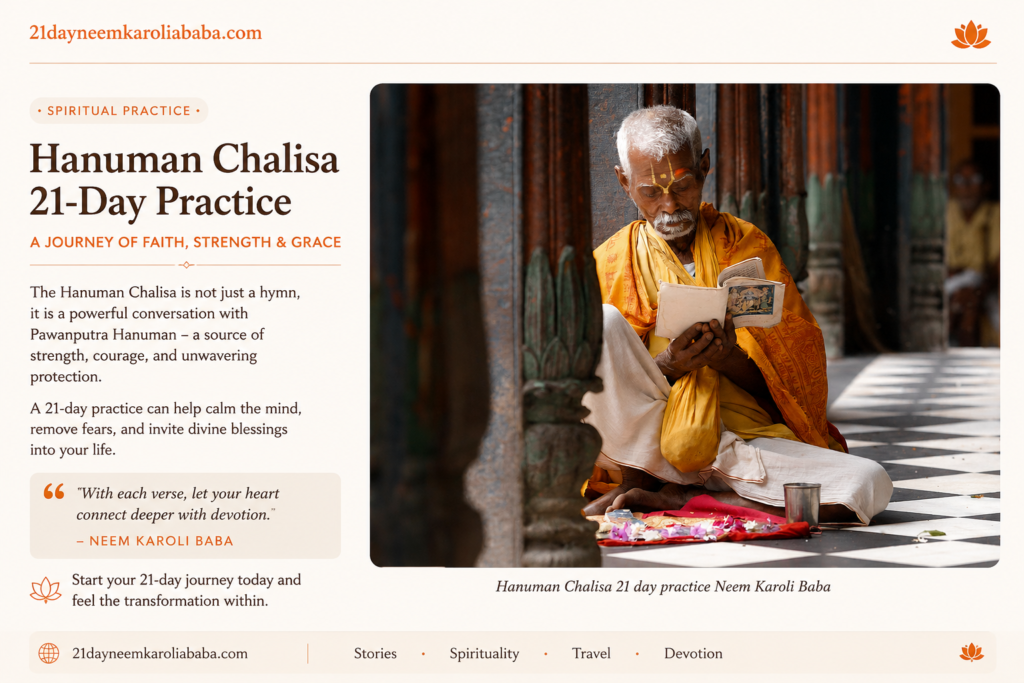
Twenty-one days of Hanuman Chalisa. Twenty-one days of seva. Twenty-one days of chanting Ram’s name with actual attention, not on autopilot.
Jobs didn’t go to India for a weekend. He stayed for months. The change wasn’t instant. It was slow and sometimes uncomfortable. He got sick. He sat in dust and heat with questions that had no fast answers.
That’s the real practice. Not the Instagram version.
Maharaj ji never taught dramatic transformation. He taught showing up every single day—with what you have, where you are—and offering it fully. To God. To the people around you. To your work. Without attaching yourself to a specific result.
Jobs did this in his difficult and flawed way. Zuckerberg was searching for the same thing when he sat in Kainchi.
This is what the 21-day sadhana is asking of you, too.
Start Your 21-Day Hanuman Chalisa Challenge—How It Works
Why This Story Keeps Finding New People
Every year, a fresh wave of people discovers Neem Karoli Baba. Some come through Ram Dass’s book Be Here Now, which has never gone out of print since 1971. Some come through Virat Kohli—he and Anushka Sharma have visited Kainchi Dham several times, and each time a new generation of fans starts searching for Maharaj ji. Some arrive through exactly this path: reading about Steve Jobs and ending up here.
The reason this story keeps moving is not that it’s a clever angle. It’s because it’s true. And it touches something a lot of people are quietly carrying — especially people who are doing well by conventional measures and still feel like something is off.
Jobs had everything Western ambition produces. He still got on a plane to go sit in an ashram. He didn’t talk about it much publicly. But he said, near the end of his life, that his time in India and his practice of Zen were among the most important shaping forces of his work.
Maharaj ji’s grace has a way of finding whoever needs it. No discrimination by religion, nationality, education, or status. The only question it asks is: Are you paying attention?” Are you showing up? Are you willing to love people without an agenda?
If yes, the rest tends to sort itself out.
Neem Karoli Baba Miracles: Real Stories from Devotees
You Don’t Need to Go to Kainchi to Start
You don’t need to book a train to Kathgodam to feel what Jobs felt there.
Start the Hanuman Chalisa today. Not when life gets calmer. Not after this project is done. Today, however many minutes you have.
Do it for 21 days straight and just notice what shifts. Not in a dramatic sense. Just watch what happens to your mind when you give it one clean, daily practice and actually follow through.
Jobs came to India with nothing and returned with a clarity that shaped everything he built for the next 35 years. Zuckerberg came when he was lost and went back to work feeling grounded enough to keep going.
You don’t need to travel anywhere.
Maharaj Ji already answered this. He said, “If you remember me, I will come.”
He wasn’t being poetic. He meant it.
Ram Ram.
Note: This post is based on personal devotion, publicly available information, and genuine research—no affiliation with any person or organization mentioned.