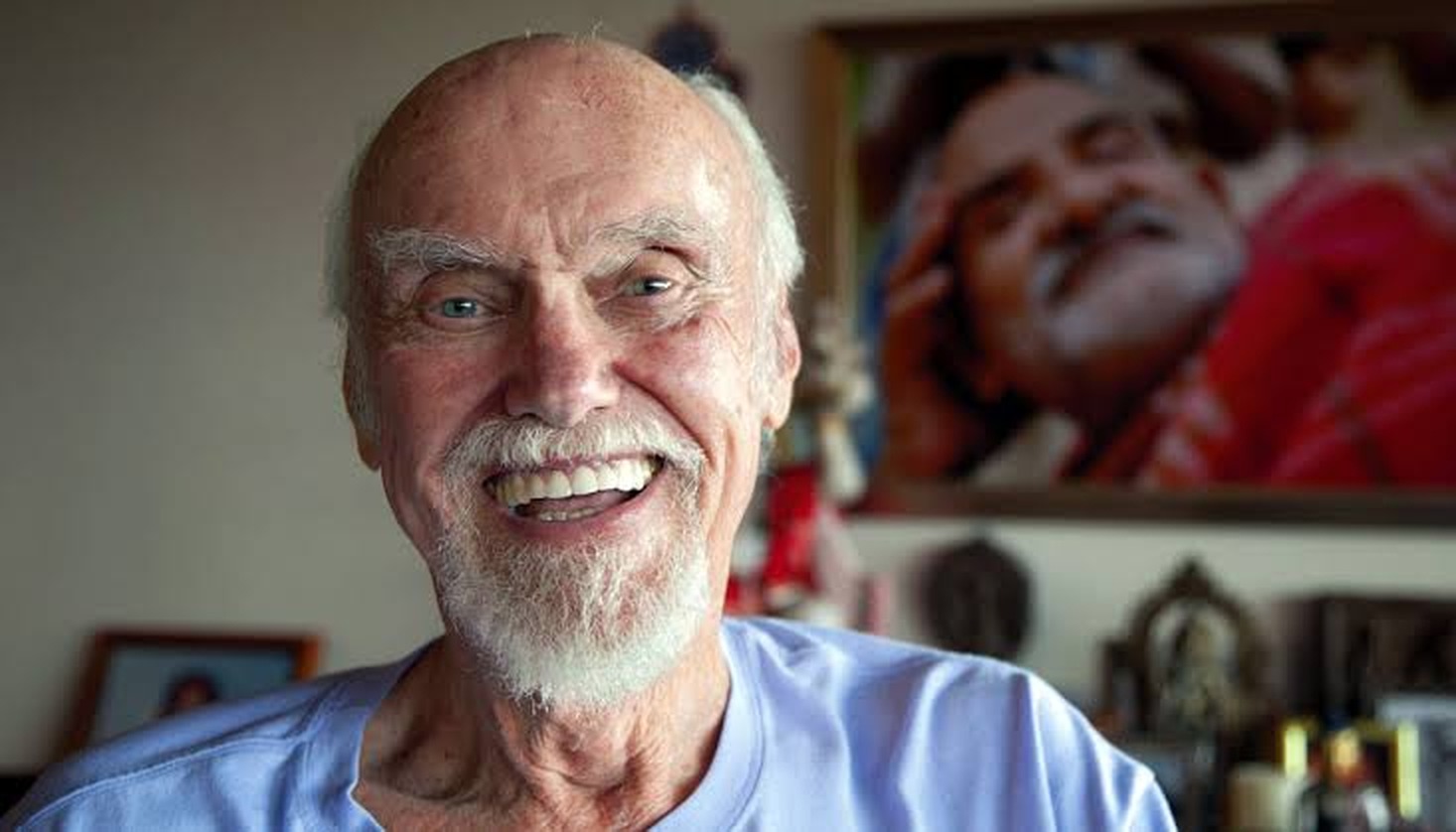
If one person carried Neem Karoli Baba’s name to the wider world, it was Ram Dass. Before he was Ram Dass, he was Richard Alpert — a Harvard psychology professor. After meeting Maharajji in India in 1967, he became a disciple, took a new name, and wrote a book, “Be Here Now”, that introduced a whole Western generation to yoga, meditation, and the idea of a living guru. And then he spent the rest of his life turning devotion into service: prisons, the dying, and the blind.
This is the story of how a man who studied the mind from the outside came to surrender it, and what he did with that surrender.
Ram Dass at a Glance
| Born as | Richard Alpert, 6 April 1931, Boston, Massachusetts, USA |
| Education | Tufts University (BA), Wesleyan University (MA), Stanford University (PhD, Psychology) |
| Before India | Assistant professor of clinical psychology, Harvard University; research with Timothy Leary |
| Met Maharajji | 1967, in India, introduced by Bhagavan Das |
| Name given | Ram Dass — “servant of God” (servant of Ram) |
| Best-known book | Be Here Now (1971) |
| Foundations | Hanuman Foundation (1974); Seva Foundation (1978, with Larry Brilliant and Wavy Gravy) |
| Later years | Stroke in February 1997; lived in Maui, Hawaii |
| Passed away | 22 December 2019, Maui, Hawaii, aged 88 |
The Harvard psychologist
Richard Alpert was born in 1931 into a well-known Boston family — his father George Alpert was a lawyer, a railroad president, and one of the founders of Brandeis University. Young Richard studied psychology at Tufts, Wesleyan, and Stanford, and by 1958 he was an assistant professor of clinical psychology at Harvard.
At Harvard he worked closely with Timothy Leary, researching the therapeutic effects of psychedelic substances. The work included the famous 1962 “Good Friday Experiment” with divinity student Walter Pahnke. The research was controversial, and in 1963 Alpert was dismissed from Harvard. By his own later account, the search that had driven the research — a search for a state of consciousness beyond ordinary life — was still unanswered. That unanswered search is what eventually took him to India.
The journey to India, 1967
In 1967, Alpert travelled to India. There he met the American spiritual seeker Bhagavan Das, who guided him through India and introduced him to Neem Karoli Baba, whom Alpert would call Maharaj-ji.
Ram Dass himself told the story of their early meetings many times. Curious about what his new guru would make of the “medicine” he had studied at Harvard, he gave Maharajji a dose the day after their first meeting. Maharajji asked for more, and then more again — several times a normal dose in total — and, by Ram Dass’s own account, showed no psychotropic effect at all. Instead, Maharajji told him that the same state could be reached through meditation, and lived in permanently. The point of the story, as Ram Dass always told it, was not the substance — it was that the state he had been chasing through chemistry was available through practice, and through grace.
After this, Maharajji became his guru, and gave him the name Ram Dass — servant of God, servant of Ram. Ram Dass studied with Maharajji for the following four years.
Be Here Now (1971)
When Ram Dass returned to America, he carried the teachings with him in a form the West had never seen. “Be Here Now”, published in 1971 by the Lama Foundation, was part memoir, part hand-lettered, illustrated manual of yoga and meditation. It explained Hindu and Buddhist practices in plain language for readers with no background in them, and it sold more than two million copies.
The book’s title became its teaching: be here, now — not in the past, not in the future, not in the next experience. For millions of readers, it was the first door into Eastern spirituality, and it made Ram Dass one of the most widely read spiritual teachers of the twentieth century.
Seva in action: two foundations
Ram Dass did not keep the teaching as words. He turned it into organised service.
In 1974 he founded the Hanuman Foundation, a nonprofit for the spiritual well-being of society through education, media, and community service. Among its projects were the Prison-Ashram Project — bringing meditation to incarcerated people, now known as the Human Kindness Foundation — and the Living/Dying Project, supporting conscious care of the dying.
In 1978 he co-founded the Seva Foundation with public health leader Larry Brilliant and activist Wavy Gravy. Seva joined with health-care workers to treat blindness in India, Nepal, and other developing countries, and grew into an international health organisation. Service, for Ram Dass, was not separate from devotion — it was devotion, in work clothes.
He also gathered the stories of Maharajji’s grace in “Miracle of Love” (1995), the collection in which Dada Mukerjee is mentioned in passing — a small thread tying the Indian and Western circles of devotees together.
The stroke as grace
In February 1997, Ram Dass had a severe stroke that left him partially paralysed and, for a time, unable to speak. He recovered his speech and kept teaching — and, in his own words as retold by those close to him, he came to see the stroke itself as a form of grace: a teacher that made him more compassionate and more humble.
After a serious illness during a trip to India in 2004, he moved to Maui, Hawaii, where he hosted retreats and taught online. He did not leave the Hawaiian Islands again until July 2019, when he travelled to Taos, New Mexico, for the consecration of a new Hanuman Mandir on 13 July 2019. He returned to Hawaii, and died peacefully at his home in Maui on 22 December 2019, surrounded by loved ones, aged 88.
The Love Serve Remember Foundation, which he helped establish, preserves his teachings and those of Neem Karoli Baba to this day.
What Ram Dass teaches
Three phrases sum up Ram Dass’s teaching, and all three come straight from his life. “Be here now” — presence is the practice. “Love, serve, remember” — love everyone, serve everyone, remember God. And the quiet lesson of his last twenty-two years: suffering itself can be grace, if it opens the heart instead of closing it.
That is why his story belongs on this site alongside Dada Mukerjee’s and Siddhi Ma’s. Dada shows devotion as a householder’s life; Siddhi Ma shows it as silence and service; Ram Dass shows it as a bridge — a man from Harvard who crossed to Kainchi, and then spent fifty years carrying the crossing back to the world.
Frequently Asked Questions
Who was Ram Dass?
Ram Dass (born Richard Alpert, 1931–2019) was an American spiritual teacher, psychologist, and author. A former Harvard professor, he became a disciple of Neem Karoli Baba in India in 1967, wrote the best-selling “Be Here Now” (1971), and founded the Hanuman and Seva Foundations.
How did Ram Dass meet Neem Karoli Baba?
In 1967, while travelling in India, he met the American seeker Bhagavan Das, who guided him and introduced him to Neem Karoli Baba. Maharajji became his guru and gave him the name Ram Dass.
What does the name Ram Dass mean?
It means “servant of God” — servant of Ram, or Lord Rama.
What is Be Here Now?
A 1971 book, part memoir and part illustrated manual of yoga and meditation, published by the Lama Foundation. It has sold more than two million copies and helped popularise Eastern spirituality and yoga in the West.
What is the Seva Foundation?
A foundation Ram Dass co-founded in 1978 with Larry Brilliant and Wavy Gravy, working with health-care workers to treat blindness in India, Nepal, and other developing countries.
When did Ram Dass pass away?
He died peacefully at his home in Maui, Hawaii, on 22 December 2019, aged 88.
Related Reading
- Disciples of Neem Karoli Baba
- Dada Mukerjee: The Allahabad Professor Who Shared His Home with Neem Karoli Baba
- Sri Siddhi Ma: The Silent Saint of Kainchi
- Neem Karoli Baba: Life, Miracles & Teachings
- Neem Karoli Baba Books
Disclaimer
This article is a devotee-run guide, not an official publication of any ashram, trust, or foundation. Accounts here are presented as devotee and biographical accounts, as told by Ram Dass himself and by writers close to him, not as verified history. Where sources differ, this guide says so rather than choosing one version silently. For the fullest account, read Ram Dass’s own books listed above.