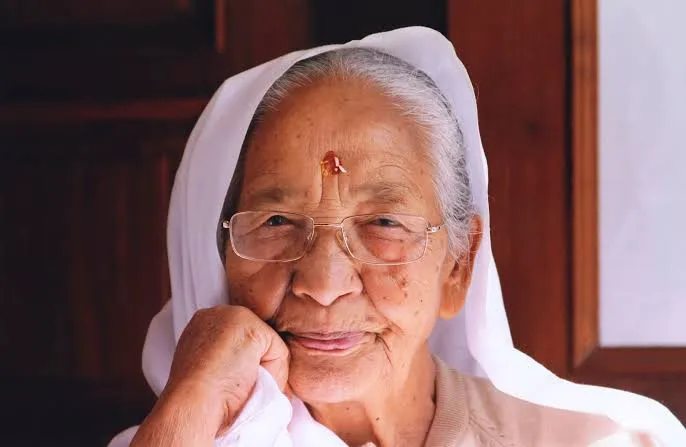
When devotees speak of Neem Karoli Baba, one name returns again and again beside his: Sri Siddhi Ma. She is often called the silent saint of Kainchi — a disciple who sought no limelight, gave no formal talks, and yet became the person devotees turned to after Maharajji left his body in 1973. For the next 44 years, it was Ma who held the ashrams and the community together, quietly, in the same spirit of love and service that Maharajji had taught.
For many devotees, understanding Maharajji is incomplete without understanding Siddhi Ma — not because she replaced him, but because she lived his teaching so completely that devotees saw him in her. This guide tells her story as devotees tell it: simply, and without inventing details the sources do not give.
Sri Siddhi Ma at a Glance
| Name | Sri Siddhi Ma (Shri Haripriya; fondly called Ma / Shri Maa) |
| From | Almora, Uttarakhand |
| Married to | Tularam Sah of Nainital |
| Family | Two sons and a daughter; family owned the India Hotel on Mall Road, Nainital |
| Life at Kainchi | Lived in the ashram’s inner quarters, devoted to seva, alongside Jivanti Ma |
| Role after 1973 | Guided Maharajji’s ashrams and devotees for 44 years |
| Mahasamadhi | 28 December 2017, at Teertham, Nainital; samadhi at Kainchi Dham |
| Book to read | Sri Siddhi Ma by Jaya Prasada (Penguin India, 2022) |
A householder from Almora
Ma came from Almora and married Tularam Sah of Nainital. She raised two sons and a daughter, and her family owned the India Hotel on Mall Road in Nainital, where Maharajji himself once stayed. Her husband was a great devotee of Maharajji, and under his influence she too drew closer to Baba.
Nothing about her early life suggests a person seeking a public spiritual role. She was a householder, a wife and a mother — and that is part of why devotees honour her so deeply. Her path was not away from ordinary life at first, but through it, until devotion became her whole life.
Meeting Maharajji
Devotee accounts differ on the details of her first meeting with Maharajji. One account places it during the construction of the Hanumangarhi temple in Nainital; another recalls her as a young bride visiting Nainital. What the accounts agree on is the direction of the story: her husband’s devotion drew her in, and her own bond with Maharajji deepened until it became the centre of her life.
Baba is reported by devotees to have regarded her as Divine Mother herself. At the Vindhyavasini temple, he is said to have told her, “Meri Vindhyavasini toh Mai hai” — my Vindhyavasini is Ma herself. Devotees repeat this line because it captures how Maharajji saw her: not as an ordinary follower, but as a mother to all who came.
The rainy night at the India Hotel
One story, recounted by Rabboo Joshi in his book “I and My Father Are One”, is told by many devotees as the turning point of her life. One dark, rainy night at the India Hotel, Baba suddenly asked her at midnight whether she could leave her household forever, at that very moment. Without a moment’s hesitation, she agreed — and asked her friend Jivanti Ma to rise and leave with her, before either of them could be caught by attachments.
Whether or not a reader takes every detail literally, the story shows what devotees remember about Ma: a readiness to surrender everything, at once, without bargaining. That readiness became the pattern of her whole life afterwards.
Life at Kainchi: seva and silence
A year after her husband’s passing, Ma left her family home and came to live permanently at Kainchi, in the inner quarters of the ashram, alongside Jivanti Ma. There she gave her life wholly to Baba’s service — quietly, without display.
She did not give formal talks. When she spoke, devotees say, her words were few and deep. She gave darshan to devotees on Saturdays and Tuesdays at Kainchi Dham, and devotees describe feeling fulfilled simply by sitting in her presence. Her teaching was the same as Maharajji’s, lived rather than lectured: love everyone, serve everyone, remember God.
The handing over: September 1973
Devotee accounts describe a quiet, symbolic moment days before Maharajji left his body. On 9 September 1973, Baba filled two pages of “Ram Ram” in his notebook, dated them 9 and 10 September, and slid the notebook towards Siddhi Ma, directing her to write in it from then on. Devotees read this as the handing over of the sacred responsibility — the guru placing his work in her hands.
Maharajji left his body on 11 September 1973 in Vrindavan. The void was immense. Many ashrams decline after their founder’s passing. Kainchi Dham did not — and devotees credit Ma’s quiet, steady leadership for that.
44 years of quiet leadership
For 44 years after 1973, Siddhi Ma guided Maharajji’s ashrams and devotees from the Kumaon hills. She kept the ashrams immaculate, kept their discipline and spirit as Maharajji had set them, and comforted the thousands who came grieving, doubting, or searching. Western devotees who had lost their guru kept their connection to Kainchi through Ma, and many came to see her as their spiritual mother.
Her reported words to the grieving community were simple: “Maharajji hasn’t gone anywhere. He is always around.” After her own passing, Ram Dass paid tribute to her in words devotees still repeat: her name means Mother of Spiritual Power, and to her spiritual family, she was simply Ma.
Mahasamadhi and remembrance
Sri Siddhi Ma left her body on the morning of 28 December 2017 at Teertham, her retreat home in Nainital. Devotees gathered there in grief and gratitude. Her samadhi is at Kainchi Dham, where she had served for decades.
Today, a visitor to Kainchi Dham who asks about Ma will hear the same summary from old devotees: she never claimed anything for herself, she never stepped into Maharajji’s place, and yet the ashram survived and grew because she lived his teaching without a break. That is why her story belongs at the start of any series on Maharajji’s devotees.
The book to read
If you want to know Ma more deeply, read “Sri Siddhi Ma: The Story of Neem Karoli Baba’s Spiritual Legacy” by Jaya Prasada (Penguin India, 2022). Prasada was Ma’s closest disciple, though she writes honestly that she was not a strong believer in her early days. Her book — full of anecdotes from her own years with Ma and Maharajji — is the fullest published account of the silent saint of Kainchi, and it is also listed on our Books page.
Frequently Asked Questions
Who was Sri Siddhi Ma?
Sri Siddhi Ma (Shri Haripriya) was one of Neem Karoli Baba’s closest disciples, known as the silent saint of Kainchi. After Maharajji’s Mahasamadhi in 1973, she guided his ashrams and devotees for 44 years until her own Mahasamadhi in 2017.
Was Siddhi Ma Maharajji’s successor?
Devotees regard her as his spiritual successor — the disciple he entrusted with his ashrams and community. She herself never claimed his place; she lived as his disciple to the end, which is why devotees honour her as both successor and servant.
Where is Sri Siddhi Ma’s samadhi?
Her samadhi is at Kainchi Dham. She left her body on 28 December 2017 at Teertham, her retreat home in Nainital.
What did Siddhi Ma teach?
She gave no formal talks. Her teaching, as devotees remember it, was Maharajji’s own teaching lived quietly: love everyone, serve everyone, remember God — through seva, silence, and surrender to the guru.
Which book should I read about her?
“Sri Siddhi Ma: The Story of Neem Karoli Baba’s Spiritual Legacy” by Jaya Prasada (Penguin India, 2022).
Related Reading
- Disciples of Neem Karoli Baba
- Neem Karoli Baba: Life, Miracles & Teachings
- Kainchi Dham: Neem Karoli Baba Ashram Guide 2026
- Neem Karoli Baba Books
Disclaimer
This article is a devotee-run guide, not an official publication of any ashram or trust. Accounts here are presented as devotee accounts, as told by devotees and writers close to Ma, not as verified history. Where sources differ, this guide says so rather than choosing one version silently. For the fullest account, read Jaya Prasada’s book listed above.