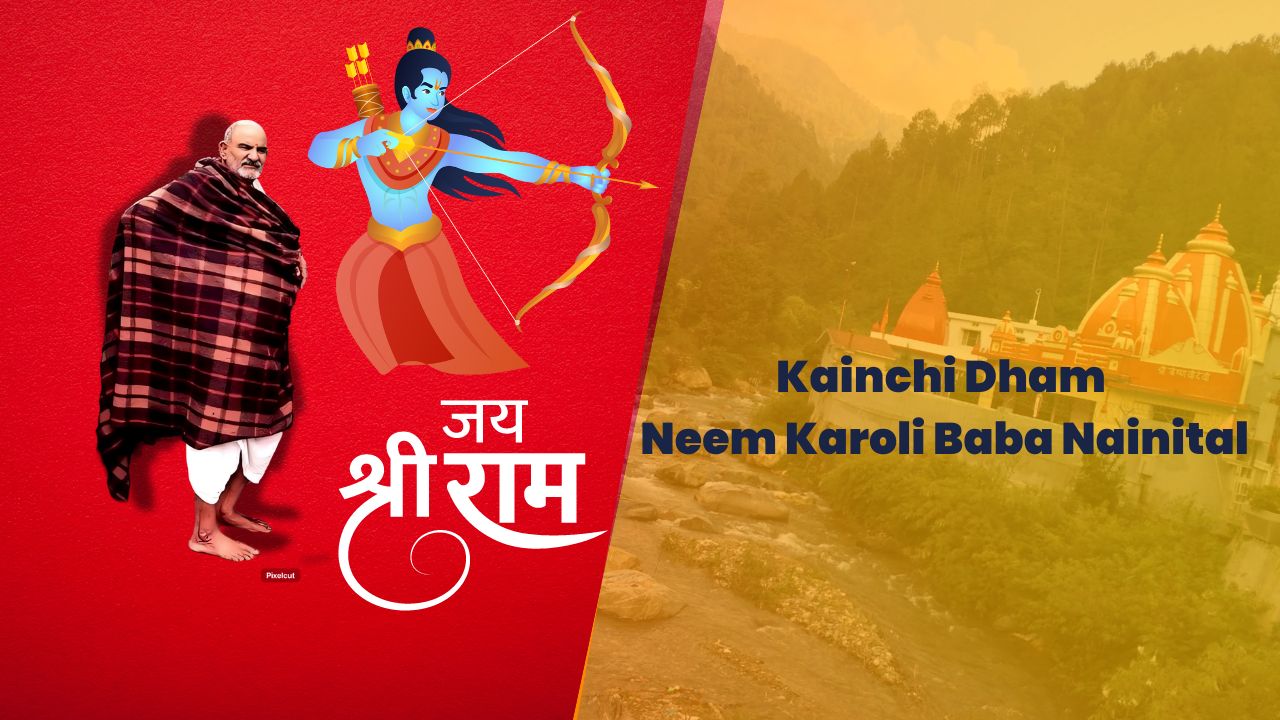
Introduction — why devotees come to Kainchi
High in the green hills of Kumaon, where the road from Nainital bends towards Almora, two streams meet in a narrow valley — and that meeting place is Kainchi. The name itself comes from that bend, that “scissors” turn in the road, and for devotees of Neem Karoli Baba, it is the most sacred address in the world.
Maharaj-ji, as his devotees lovingly call him, established this ashram in 1964, and it became the centre of his later years. He sat here wrapped in his blanket, gave darshan to whoever came — villager or foreigner, rich or poor — and taught in the simplest possible way: love everyone, serve everyone, remember God. No long lectures, no complicated rituals. Just Ram Naam, seva, and prem.
Today, Kainchi Dham draws lakhs of devotees every year. Some come for a single morning’s darshan on their way to Nainital. Some come for the Tuesday kirtan. And every year on 15 June, tens of thousands gather here for Pratishtha Divas, the foundation day of the ashram. Whether you are planning your first visit or returning after years, this guide brings together everything you need in one place: the timings, the journey, the stay, the rules, and the small practical things that make a yatra smooth.
One honest note before we begin: this website is run by devotees. It is not the official website of the Kainchi Dham ashram or the Trust. Where timings and fares are given below, they are the commonly reported schedule and approximate prices — always verify before you travel, especially in winter.
Last updated: October 2026
At a Glance
| Detail | Kainchi Dham |
|---|---|
| Full name | Kainchi Dham — Neem Karoli Baba Ashram |
| Location | Kainchi, Bhowali–Almora Road, Nainital district, Uttarakhand 263132 |
| Established | 1964, by Neem Karoli Baba (Maharaj-ji) |
| Distance from Nainital | 17 km (about 30–45 minutes by road) |
| Nearest railway station | Kathgodam (KGM), about 38 km |
| Nearest airport | Pantnagar (PGD), about 70 km |
| Darshan hours (commonly reported) | 6:45 AM – 8:00 PM daily; Tuesday till 9:00 PM |
| Entry fee | None — darshan is free |
| Main deities | Hanuman ji, with Maharaj-ji’s samadhi and temples |
| Biggest annual day | 15 June — Pratishtha Divas / Bhandara |
| Best months to visit | March–June and September–November |
| Official website | shreekainchimandirtrust.org |
History of Kainchi Dham
Neem Karoli Baba was born around 1900 as Lakshman Narayan Sharma, and by the time he came to Kainchi he was already a revered saint who had spent decades wandering, blessing, and quietly transforming lives. The story devotees tell is simple and beautiful: Maharaj-ji wanted a place in the hills where seekers could sit in peace, chant, and be fed — and Kainchi, with its river, its quiet, and its gentle climate, became that place.
The ashram was established in 1964. In the years that followed, it grew from a small temple complex into a living centre of bhakti. Western seekers began arriving in the late 1960s and early 1970s — Ram Dass, Krishna Das, Bhagavan Das and others — and through their books and music, Maharaj-ji’s name travelled far beyond India. Later, the visit of Apple co-founder Steve Jobs in the 1970s, and Mark Zuckerberg’s visit decades later on Jobs’s advice, brought Kainchi into global headlines. But for the devotees who come every week from Haldwani, Bhowali and Nainital, none of that matters as much as the daily reality: morning aarti, prasad, and the feeling of sitting where Maharaj-ji sat.
The temples here are dedicated to Hanuman ji, whom Maharaj-ji worshipped as his beloved deity. The white-marble temple, the life-size Hanuman idol, and Maharaj-ji’s own samadhi shrine together make Kainchi not just a temple visit but a complete darshan — of the Guru, and of the God he served.
What to see inside the ashram
Kainchi is compact and walkable, and no vehicles go inside the complex. Take your time; there is no rush here, and that is part of the blessing.
The main temple and Hanuman shrine form the heart of the ashram. Devotees offer flowers, sit for a while in front of the deities, and chant. Just above the main temple are the meditation hall and a small library of spiritual books, where you can sit quietly away from the crowd. A steep path leads down to the sacred stream that runs through the valley, and a trail behind the ashram leads towards the cave where Maharaj-ji is said to have meditated.
Do not try to “cover” Kainchi in fifteen minutes. Sit. Listen to the kirtan if it is going on. Take prasad if it is being served. The ashram rewards slowness — that is why so many devotees say one visit changes the pace of their whole life.
Darshan timings and aarti — the commonly reported schedule
Please read this section with care, because honesty matters more than a neat table. The Kainchi Dham Trust publishes no fixed official darshan schedule on its website. The schedule below is the one most guidebooks, travel sites and devotees report, and it has been stable across sources checked in October 2026. Treat it as the commonly reported schedule, not as an official announcement — and verify before you travel at shreekainchimandirtrust.org, especially in winter, when hours shift earlier.
| Session | Commonly reported timing |
|---|---|
| Ashram opens | 6:45 AM |
| Morning aarti — Baba’s Darshan Hall | 6:45 AM |
| Morning aarti — Hanuman Mandir | 7:00 AM |
| Morning chai | Around 7:00 AM |
| Prasad lunch | 12:30 PM (Tuesday, Friday, Saturday, Sunday) |
| Brief afternoon closure | A short closure for cleaning and offerings (exact hours vary by source) |
| Evening aarti — Baba’s Darshan Hall | 6:45 PM |
| Evening aarti — Hanuman Mandir | 7:00 PM |
| Ashram closes | 8:00 PM (9:00 PM on Tuesday) |
Tuesday is the week’s highlight. After the evening aarti, the Tuesday night kirtan continues till about 9:00 PM, followed by prasadam dinner. If you can plan your visit around a Tuesday, do it — but arrive early, because Tuesdays are also the most crowded day.
In winter (roughly November to March), opening shifts to around 7:00 AM and closing to around 6:00–7:00 PM, with evening aarti earlier. Some sources also note temporary winter closures on the coldest days. This is exactly why the verify-note matters: do not plan a winter dawn arrival on the summer timings alone.
How to reach Kainchi Dham
No train or flight reaches Kainchi directly. Every journey ends on the road — the Bhowali–Almora road (NH109) — and that last stretch through the hills is itself part of the yatra.
By air
Pantnagar Airport (PGD) is the nearest airport, about 70 km away, with flights from Delhi. From Pantnagar, a taxi to Kainchi costs roughly ₹2,500 (approximate — confirm locally) and takes about two to two-and-a-half hours via Haldwani and Bhowali.
By train
Kathgodam (KGM) is the nearest railway station, about 38 km from Kainchi. It is well connected to Delhi, Lucknow and other cities. From Delhi, the most beloved option among devotees is the Ranikhet Express (train 15013), which leaves Old Delhi late in the evening and reaches Kathgodam early in the morning — the same train our own Delhi-to-Kainchi guide describes in detail, reaching Kathgodam around 5:00 AM, in good time for the first buses and shared taxis of the day. From Kathgodam, the road climbs through Haldwani and Bhowali to Kainchi in about one-and-a-half hours.
By road
From Delhi, Kainchi is about 320–330 km and takes 7–9 hours by road, via NH9 through Moradabad and Rampur to Haldwani, then up the hill road via Kathgodam and Bhowali. Government and private buses run from Delhi (Anand Vihar ISBT) to Haldwani and Nainital; from there, local taxis and buses complete the journey. From Nainital, it is a short and beautiful 17 km drive, about 30–45 minutes.
Route, distance and fare table (approximate — check locally)
| Route | Distance | Time | Approximate fare |
|---|---|---|---|
| Delhi → Kainchi Dham | 320–330 km | 7–9 hours | Bus ₹400–₹1,500 depending on type; tolls ~₹400 by car |
| Delhi → Kathgodam (Ranikhet Express 15013) | Overnight train | ~10 hours overnight | Sleeper/AC as per railway fare |
| Kathgodam → Kainchi Dham (private taxi) | ~38 km | ~1.5 hours | ₹1,500–₹2,500 one way; round trip with waiting ₹2,800–₹3,800 |
| Kathgodam → Kainchi Dham (shared taxi/jeep) | ~38 km | ~1.5 hours | ₹100–₹350 per seat (mornings best) |
| Kathgodam → Kainchi Dham (bus) | ~38 km | 1.5–2 hours | ~₹95–₹120 per seat; KMOU buses to Almora/Ranikhet stop at Kainchi |
| Haldwani → Kainchi Dham | 43–49 km | 1h25–1h40 | Shared taxi ~₹120–₹350; private cab similar to Kathgodam rates |
| Nainital → Kainchi Dham | 17 km | 30–45 minutes | Shared taxi/jeep ₹100–₹300 per person; private cab ₹300–₹1,200 |
| Pantnagar airport → Kainchi Dham | ~70 km | ~2–2.5 hours | Taxi ~₹2,500 |
| Delhi route lived detail (from our Delhi guide) | Old Delhi → Kathgodam by Ranikhet Express | Overnight | Shared taxi from Kathgodam ~₹300; bus ~₹105 (as reported in our Delhi post — fares change, confirm on the day) |
A practical note from the Delhi route that devotees swear by: reach Kathgodam early, and you will find shared taxis and buses waiting. Arrive late in the day, and you may have to hire a private cab. On the return journey, note that there is no easily bookable bus back down from Kainchi in the evening — shared taxis thin out, so plan your return before dark, or arrange your cab’s waiting time in advance. Parking near the ashram is in a designated lot a short walk before the gate (about ₹50 per car as last reported); on crowded days, park at Bhowali and walk or take a local jeep the last stretch.
Best time to visit
Kainchi is open all year, and every season has its devotees. But the experience changes a lot with the weather, so choose with your eyes open.
| Season | Months | What to expect | Verdict |
|---|---|---|---|
| Spring | March–April | Pleasant days, clear skies, moderate crowds | Excellent — one of the best windows |
| Summer | May–June | Warm days, cool evenings; 15 June brings huge crowds | Very good, except 15 June itself if you dislike crowds |
| Monsoon | July–September | Lush green hills, occasional landslides and slush on hill roads | Good for the devoted; check road conditions |
| Autumn | October–November | Clear, crisp air after the rains; comfortable for walking | Excellent — arguably the finest season |
| Early winter | December (first 3 weeks) | Cold but clear, fewer crowds | Very good for a quiet darshan |
| Deep winter | January | Snow and fog possible; road closures and reduced ashram hours possible | Avoid unless you are prepared |
| Festive rush | 24 December – 2 January | 30,000–40,000 weekend visitors in the Nainital belt; hotel rates can triple | Avoid if you want peace |
The sweet spots most regular visitors name are the first three weeks of December and the second half of February — cold but clear, with fewer crowds. Weekdays are always calmer than weekends, and arriving before 9:00 AM on a weekday gives you the quiet Kainchi that devotees describe.
Where to stay
There is no online room booking for the ashram itself — beware of any website that claims to sell ashram rooms online. Ashram stay, where available, is arranged through the Trust’s own offline process, and you should confirm directly rather than through agents. No outside agent is authorised for ashram stays, darshan or donations — a warning the Trust itself emphasises.
For most visitors, the practical choice is to stay in Bhowali (about 7 km before Kainchi), Nainital (17 km), or Haldwani/Kathgodam (at the foot of the hills). Our Delhi guide’s lived price bands give a fair sense of the range: simple dorm-style stays around ₹500, and decent hotels in the ₹1,500–₹2,500 range — but prices move sharply with season, and on 15 June and the Christmas–New Year week you must book weeks or even months ahead. Staying in Bhowali has one special advantage: you can reach Kainchi for the morning aarti without a long early climb, and return easily after the evening aarti.
Ashram rules and etiquette
Kainchi runs on discipline and simplicity, and the rules are really just respect in practice:
- Dress modestly — no shorts or sleeveless clothing for men or women.
- Keep mobile phones on silent throughout the ashram, and do not photograph inside the main sanctum.
- Maintain silence during aarti and satsang; let the chanting carry you rather than conversation.
- Remove shoes where asked, and follow the directions of the ashram volunteers — they manage crowds with great patience, especially on Tuesdays and 15 June.
- Take prasad with gratitude and do not waste it. If you wish to offer seva, ask the ashram staff rather than arranging anything through a tout.
- Do not pay anyone who claims to arrange “special darshan” or “VIP entry” — darshan at Kainchi is free and open to all, and that equality is part of Maharaj-ji’s teaching.
Nearby places to visit
Kainchi sits in a region full of quiet beauty, and most devotees combine it with one or two nearby stops. Nainital, 17 km away, with its lake and Naina Devi temple, is the natural pairing. Bhimtal and Sattal, with their calmer lakes, suit those who want a slower day after darshan. Almora, about 45 km further along the same road, is the gateway to the wider Kumaon hills. And devotees of Maharaj-ji often also visit Bhumiadhar and Kakrighat nearby, places associated with his life and wanderings. If you have an extra day, spend it unhurried — the hills around Kainchi are not a checklist, they are a continuation of the same peace. If you are planning a wider trip, see where Neem Karoli Baba’s other mandirs are located.
15 June — Pratishtha Divas and the annual Bhandara
Every year on 15 June, Kainchi Dham celebrates Pratishtha Divas, the day the Hanuman ji idols were consecrated — the foundation day of the ashram. It is the biggest day of the year here: tens of thousands of devotees, kirtan through the day, and the famous Bhandara, where the community feast is served to all. Malpua prasad is the beloved speciality of the day.
The practical reality matters as much as the devotion. In recent years, police have restricted private vehicles near the ashram around 15 June, with parking zones and shuttle arrangements; devotees often park 2–3 km away and walk. Book your stay two to three months ahead, book trains early, and arrive by around 6:00 AM if you want a calm darshan before the crowds peak. Our dedicated 15 June post covers the devotional meaning of the day in full — this guide’s point is simpler: come for the Bhandara, but come prepared.
Planning your day — a simple itinerary
A first-timer’s day could look like this: reach Kathgodam early by the overnight train, take a shared taxi up to Kainchi, and arrive in time for the morning aarti. Spend the morning sitting in the temple and the meditation hall, take prasad lunch if it is a prasad day, and walk down to the stream in the afternoon. Attend the evening aarti, and return to Bhowali or Nainital before dark. If it is a Tuesday, stay for the kirtan — it is the week’s most moving evening, and the prasadam dinner afterwards is a memory devotees carry home.
One day is enough for darshan. Two days — with a night in Bhowali — let you attend both a morning and an evening aarti without rushing. That unhurried second morning is when many first-time visitors say Kainchi truly “opened” for them.
Frequently asked questions
What are the darshan timings of Kainchi Dham?
The commonly reported schedule is 6:45 AM to 8:00 PM daily, with Tuesday extended till 9:00 PM for kirtan. Morning aarti is at 6:45 AM in Baba’s Darshan Hall and 7:00 AM in the Hanuman Mandir; evening aarti follows the same pattern at 6:45 PM and 7:00 PM. The Trust publishes no fixed official schedule, so verify at shreekainchimandirtrust.org before you travel, especially in winter.
Is there an entry fee at Kainchi Dham?
No. Darshan is free, and no ticket is required. Be cautious of anyone charging for entry or “special darshan”.
How far is Kainchi Dham from Nainital?
17 km by road, about 30–45 minutes. The route runs Nainital → Bhowali → Kainchi on the Bhowali–Almora road.
Which is the nearest railway station to Kainchi Dham?
Kathgodam (KGM), about 38 km away. From Delhi, the Ranikhet Express (15013) is the favourite overnight option among devotees, reaching Kathgodam early in the morning.
Which is the nearest airport to Kainchi Dham?
Pantnagar Airport (PGD), about 70 km away, with flights from Delhi. A taxi from Pantnagar to Kainchi costs roughly ₹2,500 and takes about two to two-and-a half hours.
What is the best time to visit Kainchi Dham?
March–June and September–November are the best windows. The first three weeks of December and the second half of February are quiet sweet spots. Avoid January (snow, fog, possible road closures) and the 24 December – 2 January rush if you want a peaceful darshan.
Can I book accommodation at the ashram online?
No — there is no online ashram room booking, and no outside agent is authorised for ashram stays. Stay in Bhowali, Nainital or Haldwani instead, and confirm any ashram stay directly through the Trust’s own process.
What happens on 15 June at Kainchi Dham?
15 June is Pratishtha Divas, the ashram’s foundation day, celebrated with a massive Bhandara (community feast, including Malpua prasad). Expect tens of thousands of devotees, traffic diversions, and parking 2–3 km away. Book stay and trains well in advance and arrive by around 6:00 AM.
Are photography and mobile phones allowed inside the ashram?
Phones must be kept on silent, and photography is not permitted inside the main sanctum. Follow the volunteers’ guidance and maintain silence during aarti.
Is Kainchi Dham open in winter?
Yes, it is open all year, but winter hours shift — opening around 7:00 AM and closing around 6:00–7:00 PM, with earlier evening aarti. Always verify the current schedule before a winter visit, as temporary closures on the coldest days are possible.
A closing thought
Devotees often say that Maharaj-ji did not ask for anything complicated: love everyone, serve everyone, remember God. Kainchi Dham is where that teaching still lives as a daily routine — aarti at dawn, prasad at noon, kirtan on Tuesday nights, and a blanket’s worth of compassion for whoever walks in.
If this guide helps you plan your yatra, it has done its work. Come with an open heart, travel safely, verify the timings before you leave, and take home not just photographs but a little of Kainchi’s stillness. Ram Ram.